Choosing the Right Garden Parasol for a Table: 2026 Guide
What if the best patio umbrella size depends less on your tabletop than on the chairs around it? When choosing the right size patio umbrella for a table, measuring only the table can leave diners sitting beyond the shade. The canopy needs to cover the dining area people actually use, with room for chairs and movement.
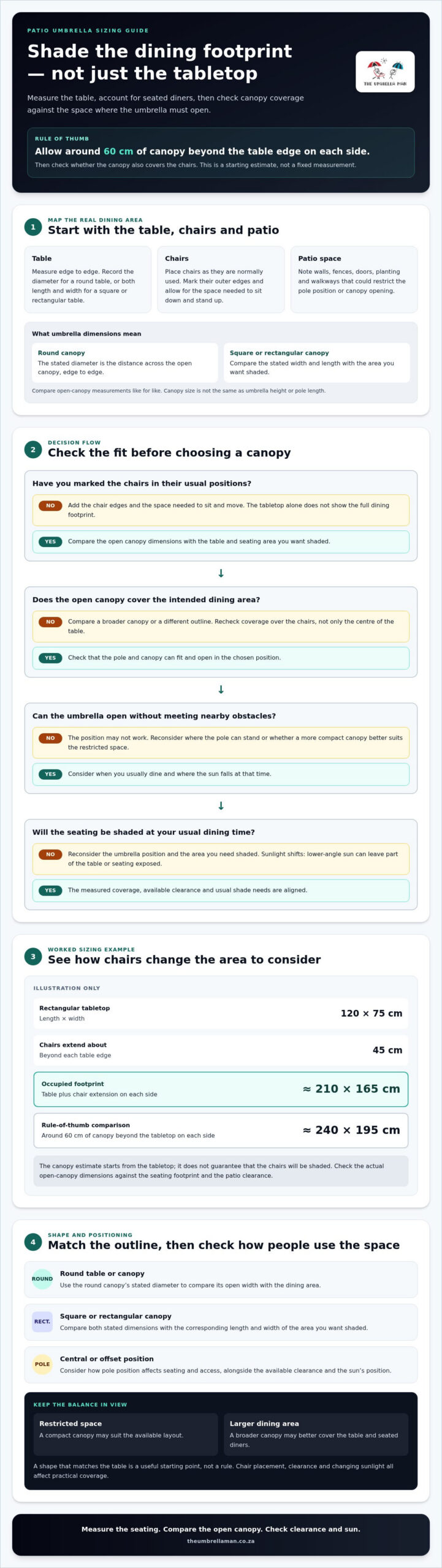
It can be hard to picture how a canopy measurement translates to coverage, or to know whether a round, square or offset design suits your layout. This guide explains how to measure the table and seating area, estimate a suitable canopy size, and choose a shape and position that work for your space. As a practical rule of thumb, aim for the canopy to extend around 60 cm beyond the table on each side, then check whether that also covers the chairs.
Clearance, the table opening and the umbrella base can all affect your choice. The Umbrella Man’s range includes a 2.56m Garden Pattern Umbrella, one option to compare for outdoor dining at home or in a hospitality setting.
Key Takeaways
- When choosing the right size patio umbrella for a table, measure the tabletop and mark where chairs sit before comparing canopy dimensions.
- Match the canopy shape to the table, and consider how a central or offset pole affects seating and access.
- Check the umbrella’s opening space against nearby doors, walkways and structures before choosing its position.
- Plan shade around the times you usually dine, as the sun’s position changes the area covered.
- Balance coverage with the limits of your layout: a compact canopy may suit a restricted space, while a broader one may better cover a larger dining area.
Choosing a patio umbrella size starts with the shaded dining area
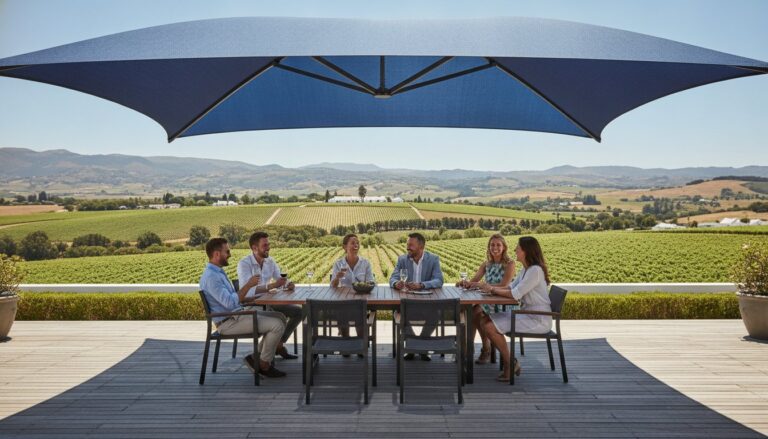
Plan shade around the people using the table, not the tabletop alone. Diners sit beyond its edges, and chairs need room to move. The useful coverage area is the table plus the occupied seating space, considered alongside where the sun falls during the times you expect to dine.
Suitable table-umbrella coverage is the open canopy area positioned to shade the table and diners seated around it during normal use. It’s a practical guide, not a fixed measurement: the right coverage depends on your furniture arrangement, sun exposure and available space.
What does patio umbrella size actually measure?
For a round canopy, its stated diameter is the distance across the open canopy, from one edge to the opposite edge. It doesn’t describe the canopy’s height or the length of the pole. Square and rectangular canopies may instead be described by width and length, so compare dimensions as the manufacturer presents them.
Picture a top-down plan: draw the open canopy as a circle or rectangle, then mark the table and pulled-out chairs underneath. This helps you see whether the canopy covers the dining arrangement, rather than just the centre of the table. The broader history and types of umbrellas also helps explain why parasols come in different designs and forms.
When comparing options, use the manufacturer’s stated open-canopy measurement consistently. Don’t compare a canopy diameter with an umbrella’s overall height, or assume a longer pole provides more shade. These measurements describe different features and affect different aspects of fit.
Why table dimensions alone do not determine coverage
A table measurement gives you a starting point, not the full area to shade. Place the chairs where they’d normally be used and consider how far they extend when diners are seated. A canopy that covers the tabletop may still leave diners or chairs exposed, particularly during a longer meal.
Sun direction also affects useful shade. When the sun is high, shade tends to fall closer to the area beneath the canopy. At lower angles, it can stretch to one side, leaving part of the table or seating exposed. Think about when you usually dine and where the sunlight falls at those times. The sun’s movement matters as much as the canopy’s size.
Finally, check the surrounding layout. A wall, fence, planting or another structure may restrict where the pole can stand or how the canopy can open. These obstacles can make a larger umbrella impractical in one position, even if its canopy seems suitable on paper. For home dining and hospitality settings alike, choosing the right size patio umbrella for a table means balancing shade for seated guests with the space available to position and use it.
How to measure a table and calculate a suitable patio umbrella size
Start your shortlist with four considerations: the tabletop, the space occupied by chairs, the shade you want, and the open-canopy dimensions of possible umbrellas. This helps narrow the options without treating one size as suitable for every patio.
Measure the table, chairs and usable patio area
First, measure the tabletop from edge to edge. For a round table, record its diameter. For a square or rectangular table, note both the length and width. Then position the chairs as they’re normally used and mark their outer edges, including the space they need when someone sits down or stands up.
Next, measure the available area around the full arrangement. Note nearby walls, fences, doors, planting and walkways that could restrict the pole position or prevent the canopy from opening fully.
Turn your measurements into a canopy shortlist
Compare the manufacturer’s stated open-canopy dimensions with the dining footprint, not just the tabletop. For a rectangular table, compare both canopy length and width with the corresponding dimensions of the area you want shaded. For a round canopy, use its stated diameter as the width across the open canopy.
- Measure: Record the table’s shape and dimensions.
- Mark: Add the usual chair positions and the space needed to sit and move.
- Assess: Decide which seats need shade and when you’ll usually dine.
- Compare: Shortlist canopies that cover the intended area and fit the available patio space.
Example, for illustration only: imagine a rectangular table measuring 120 cm by 75 cm. If chairs extend about 45 cm beyond each table edge, the occupied footprint is approximately 210 cm by 165 cm. A common sizing rule of thumb is to allow around 60 cm of canopy beyond the table edge on each side. Applied to the tabletop alone, that gives a rough comparison point of 240 cm by 195 cm. Use this as a starting estimate, then check whether the canopy also shades the chairs and fits the space.
The final choice depends on the layout. Clearance, chair positions and sun exposure can all change the coverage that works in practice.
Before settling on an option, review the product’s stated dimensions and instructions for positioning and use. Compare canopy coverage with the available space, while accounting for the pole and base as well as the table and chairs.
With your measurements in hand, compare them against The Umbrella Man’s outdoor umbrella range.
Round, square or offset: match umbrella shape to the table
Canopy shape affects how shade falls across the table and seating, while pole position determines how easily people can sit down and move around. Matching the umbrella outline to the table is a useful starting point, but it isn’t a rule: chair placement, available clearance and the sun’s position can matter more.
Which canopy shape works with round or square tables?
A round canopy can give balanced coverage around a centred round table. A square canopy may align neatly with a square table or compact dining arrangement, making its edges easier to compare with the layout. Rectangular canopies generally follow the longer outline of rectangular tables, helping distribute shade along the table’s length. These are practical pairings, not guarantees of full coverage.
Use the comparison below as a starting point, then check the canopy dimensions against the actual dining arrangement.
Round canopy
Often suits a round table, particularly when the table and canopy share a central position. Over a long rectangular table, its curved edges may leave the ends less covered.
Square canopy
Often aligns well with a square table or compact square layout. It can also suit other shapes if its dimensions and position cover the intended seating.
Rectangular canopy
Often works with a rectangular or oval table because its longer outline can follow the table’s length. Check that its width also suits the chairs and available space.
Shape matching is only a guide. For example, a square canopy may be more practical than a round one for a square table if the surrounding layout has a narrow edge or a nearby obstruction. In hospitality settings, where the look of several dining areas matters as well as coverage, a guide to custom branded umbrellas can help inform plans for branded outdoor shade.
When should you consider an offset umbrella?
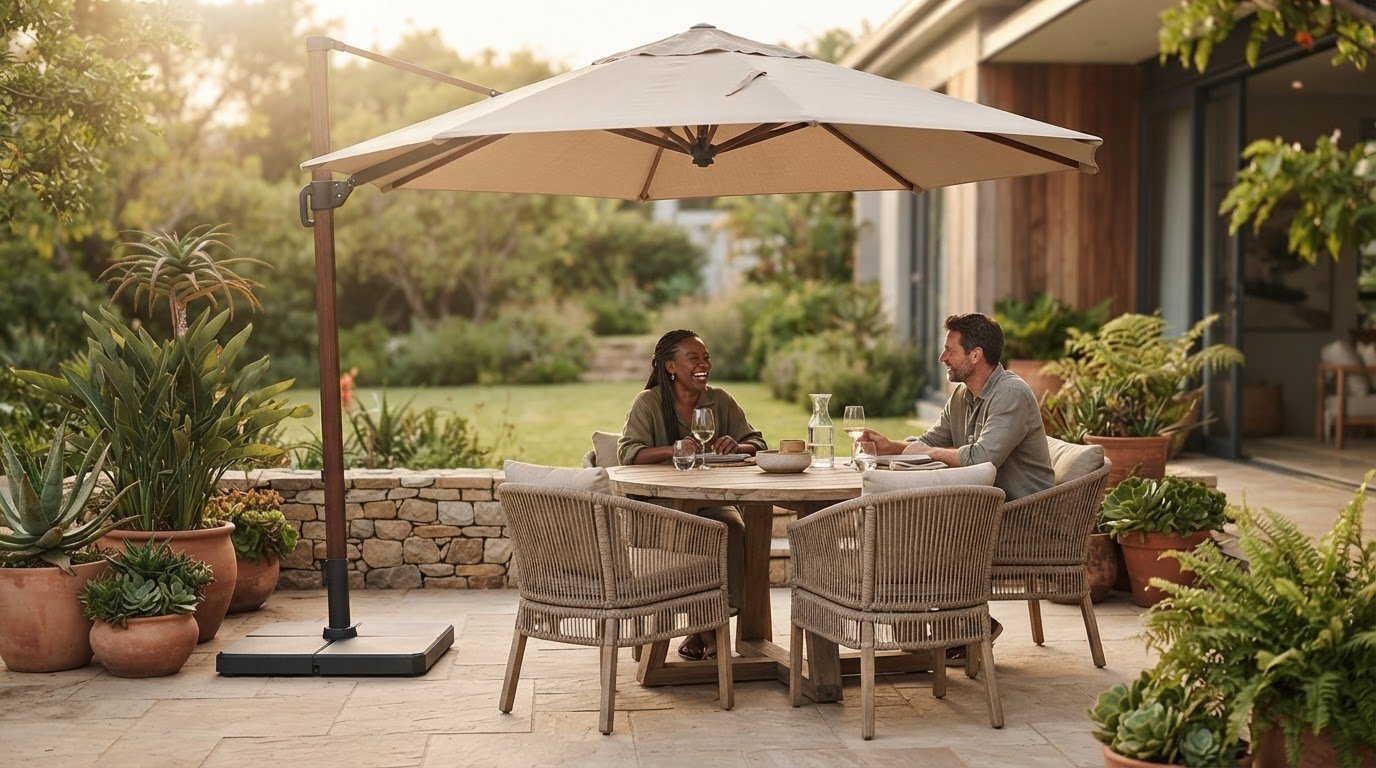
A centre-pole umbrella places its support through the middle of the canopy and, where the table is designed for it, through the table opening. This can keep the base close to the table, but the pole may occupy central space or affect how diners arrange their seats. Check the table opening and chair positions before deciding that a centre-pole arrangement will work—especially for bespoke solid wood furniture from makers like The Table Guy, where modifying the tabletop may not be desirable.
An offset umbrella holds the canopy to one side of its support. This can leave the central seating area unobstructed, which may help where a pole would interfere with access. However, the base still needs a suitable position, and the canopy needs room to open without blocking chairs, walkways or nearby structures. An offset design isn’t automatically the better option: its footprint must fit the patio.
A gazebo is a different shade format, with a broader structure to plan around rather than a single umbrella pole. It may suit a different outdoor layout, but requires its own assessment of space and placement. The gazebo selection and durability guide covers that alternative.
Check clearance, shade movement and stability before choosing
A canopy can suit the table on paper and still be awkward to use if it blocks a doorway, crowds a walkway or catches on nearby branches. Before choosing the right size patio umbrella for a table, assess the full setup: open canopy, pole or support, base, chairs and the routes people use around them.
Use this checklist to assess the space:
- Opening space: Can the canopy open fully without hitting a wall, branch, roof edge or overhead fitting?
- Access: Do doors and walkways remain usable when the umbrella is open and chairs are occupied?
- Position: Can the pole and base sit securely without interfering with seating or movement?
- Storage: Is there room to close the canopy and move or store it when the dining area isn’t in use?
Allow room to open and use the umbrella
Test the intended position with chairs pulled out, not tucked under the table. Check the canopy’s full opening area and consider how people will pass behind seated diners. A tight fit can make an otherwise suitable umbrella inconvenient. Plan how you’ll close it and keep it out of the way when the outdoor dining area isn’t in use.
Plan for changing sun and outdoor conditions
Useful shade shifts as the sun moves, and nearby buildings or trees can change where it falls. Sketch the dining area at the times you commonly eat outdoors. Mark the shaded area in the morning, around midday and in the afternoon. This helps show whether the canopy position works for your routine or leaves some seats exposed at a particular time.
Wind exposure matters too. An open patio, a sheltered courtyard and a spot beside a building can place different demands on an umbrella. Consider how exposed the position is and follow the product’s instructions for use and securing its base. Base suitability depends on the umbrella’s design, the surface it stands on and the conditions around it; no single base choice suits every setup. Close or secure the umbrella as directed when conditions make it unsafe to leave open. Don’t assume that a vent or a particular canopy shape makes an umbrella windproof.
For exposed outdoor settings, a guide to wind-resistant beach umbrellas offers relevant context, although beach use and patio-table placement are different situations. Assess the specific location rather than treating one setting as a direct substitute for the other.
Once you’ve checked clearance, shade timing and base position, review the outdoor umbrella options with your measurements and layout in mind.
Choose a patio umbrella size with confidence
A sound choice follows a clear sequence: measure the full dining footprint, select a canopy shape that suits the arrangement, check opening and movement clearance, then review sun and wind exposure. This grounds the decision in how the space is used, rather than relying on the tabletop measurement alone.
A more compact canopy may be practical where walls, walkways or nearby furniture limit the available area. It can provide useful shade without obstructing movement, although some seats may receive less cover. Broader coverage may matter more for a larger dining footprint or a setting where diners spend longer at the table. Aim for a workable balance between shade and usable space.
Use this final checklist before selecting a canopy
- Confirm the footprint: Record the table dimensions, chair positions and the area you want shaded.
- Check the fit: Compare canopy shape and dimensions with the dining layout, then consider where the pole and base will sit.
- Test the space: Make sure the canopy can open and close without obstructing doors, walkways or storage space.
- Review the conditions: Revisit the area at the times you usually dine and consider how sun and exposure affect the position.
Consider these details together. A canopy that seems suitable by size may be less convenient if its pole interrupts access or there is nowhere appropriate to position its base. A smaller option may be a sensible fit if it preserves circulation and shades the seats used most often.
Match the choice to home or hospitality use
For home dining, prioritise comfortable coverage and easy movement around the table. Think about how often the chairs are pulled out and whether the umbrella needs to be closed or moved when the patio is used for another purpose.
Hospitality layouts call for a broader view. Consider how customers and staff circulate between tables, whether dining arrangements are repeated across the space, and how umbrellas can be positioned without narrowing access routes. For multiple tables, assess each arrangement rather than assuming one canopy size will suit them all. Differences in table shape, nearby structures and sun exposure can affect the best fit.
The Umbrella Man’s range includes a 2.56m Garden Pattern Umbrella, one option to compare against your measurements. Its stated size alone doesn’t determine whether it will suit a particular table; the layout and intended coverage remain part of the decision.
Once you’ve completed the checks, explore The Umbrella Man’s outdoor umbrella range and compare options with your dining space in mind. A careful assessment makes choosing the right size patio umbrella for a table a more confident, practical decision.
Make your outdoor dining space work better
A well-chosen parasol can make an outdoor table more comfortable without making the surrounding space harder to use. As you take the next step in choosing the right size patio umbrella for a table, keep your measurements and usual seating arrangement close at hand. They’ll help you compare options with the way you actually use the area, whether you’re planning a home dining spot or shade for a hospitality setting.
The Umbrella Man supplies umbrellas for individual and bulk-order needs, including retail and hospitality requirements. Explore practical options while keeping your table, layout and shade priorities in view.
Explore The Umbrella Man’s outdoor umbrella range and compare options for your outdoor dining plans. With a clear idea of the space and how you want to use it, you can choose with confidence and make the most of your table.
Frequently Asked Questions
How much bigger should a patio umbrella be than the table?
A common rule of thumb is to allow the canopy to extend about 60 cm beyond the tabletop on each side. That means comparing a canopy roughly 120 cm wider than the table, where the shape allows. Treat this as a starting point, not a guarantee that every chair will be shaded. The table’s position, canopy shape and sun angle can all affect the result.
What size umbrella do I need for a six-seater table?
For a six-seater, start by measuring the table and the space occupied by its chairs; the number of seats alone doesn’t determine canopy size. As a broad guide, 10 to 11 ft canopies are commonly suggested for tables seating six to eight, but table dimensions and layout still matter. A long table may need a different canopy shape or coverage than a compact round one.
Can a patio umbrella be larger than the table?
Yes. A canopy larger than the tabletop can shade diners and chairs as well as the table, provided it fits the patio and opens without obstruction. For example, a wider canopy may be useful if chairs are regularly pulled away from broad furniture, such as the generous handcrafted dining tables UK makers build for entertaining. Check the full open span against walls, doors and walkways so added shade doesn’t make the area difficult to use.
Should a patio umbrella match the shape of the table?
Matching shapes often creates a balanced layout, but it isn’t essential. A round canopy can suit a round table, while a rectangular canopy may follow a long table more closely. Check the actual coverage before deciding: a square canopy might work well over a different table shape if its dimensions fit the seating area. Pole placement and surrounding space can matter more than visual symmetry.
Is an offset umbrella better for a patio table?
An offset umbrella can be a good choice if a central pole would interfere with place settings or seating. Its support sits to one side, leaving the table centre clearer. However, the base takes up space beside the dining area, and the canopy still needs room to open. A centre-pole design may suit a table with a compatible opening and a layout that accommodates the pole comfortably.
How do I choose an umbrella base for my patio table?
Choose a base that’s compatible with the umbrella’s pole and design, and consider the surface and exposure where it will stand. A sheltered, level patio presents different conditions from an open area exposed to gusts. Follow the umbrella maker’s guidance for base suitability and use, and position it so it doesn’t obstruct chairs or access. Don’t assume one base type or size will suit every umbrella.
Does umbrella size affect how much shade reaches the table?
Yes. A larger canopy can cover more of the table and seating, but its shape and position also influence where the shade falls. When choosing the right size patio umbrella for a table, consider whether you need shade only for the tabletop or for diners too. The sun’s angle changes during the day, so a canopy that covers the table at midday may shade it differently later.