Custom Printed Beach Umbrellas: The Professional Guide to Outdoor Branding
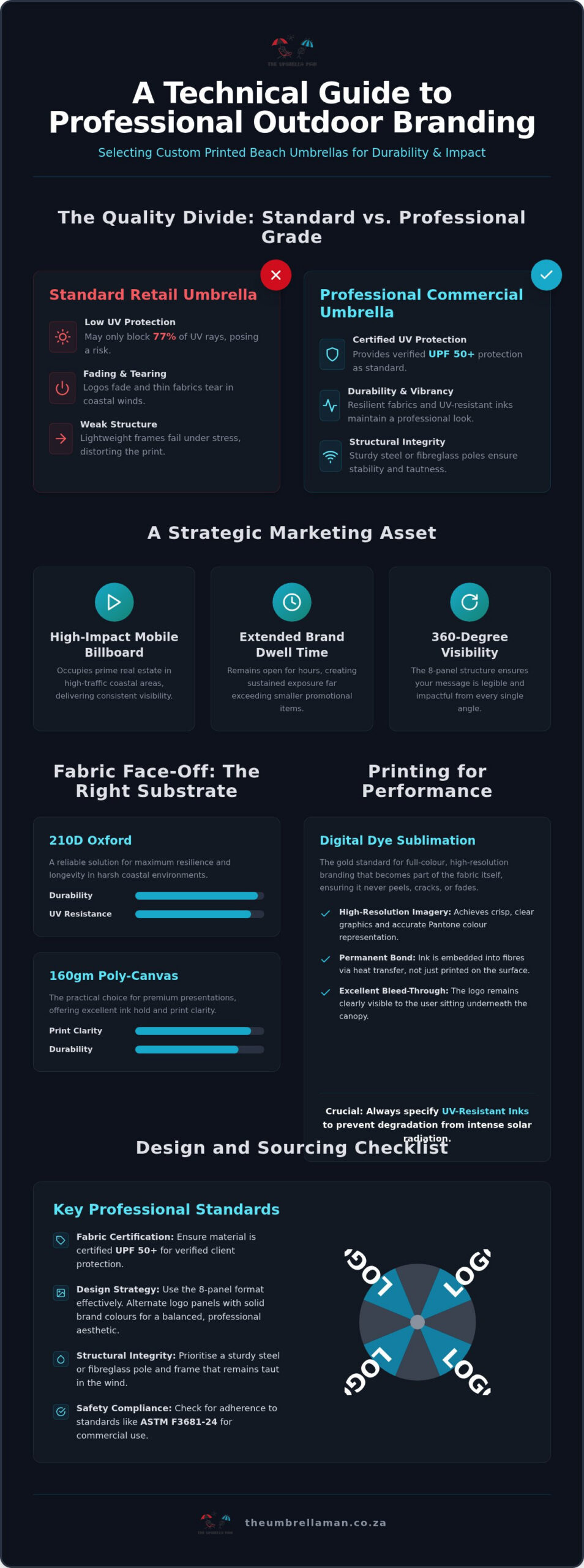
Did you know that a standard outdoor umbrella might only block 77% of UV rays, leaving both your clients and your brand’s reputation exposed to the harsh South African sun? It’s a common frustration for businesses to see a significant investment in custom printed beach umbrellas lose its impact as logos fade or fabrics tear in the coastal wind. You likely recognise that professional-grade equipment should serve as a reliable extension of your corporate identity, not a maintenance liability.
This guide provides a technical roadmap for selecting outdoor branding that withstands the elements whilst maintaining visual excellence. You’ll discover how to choose between 160gm poly-canvas and 210D Oxford materials to ensure durability and certified UPF 50+ protection. We’ll also examine the printing techniques required for accurate Pantone colour representation and structural standards, such as the ASTM F3681-24 safety requirements. By the end of this article, you’ll have the expertise needed to source equipment that reflects the high standards of your business for years to come.
Key Takeaways
- Learn why umbrellas serve as high-impact mobile billboards and how to leverage their significant brand dwell time for effective coastal marketing.
- Understand the technical differences between digital sublimation and screen printing to ensure your custom printed beach umbrellas maintain high-resolution clarity and colour accuracy.
- Compare the durability and ink absorption properties of 210D Oxford and 160gm Poly-Canvas fabrics to select the most resilient substrate for your specific environment.
- Master design strategies for circular eight-panel formats, including how to use alternating panels to balance corporate visibility with professional aesthetic appeal.
- Establish professional maintenance and procurement protocols to protect your branding investment and manage large-scale national rollouts with confidence.
The Strategic Value of Custom Printed Beach Umbrellas
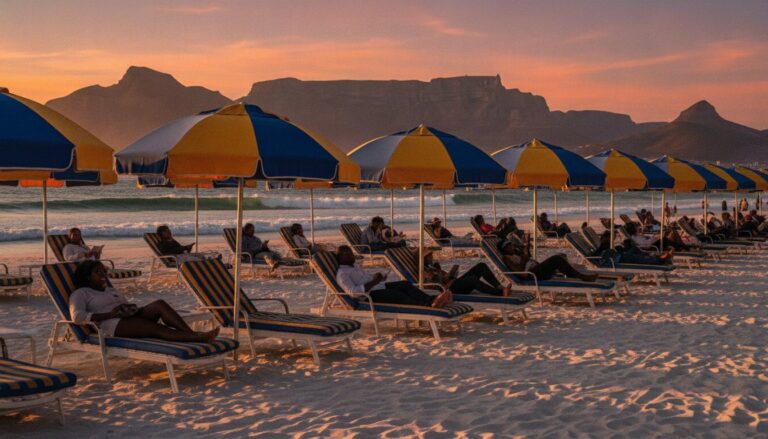
Custom printed beach umbrellas function as high-impact mobile billboards within the coastal landscape. Unlike static signage that passers-by might ignore, these units occupy prime real estate on beaches and at outdoor venues. They provide a functional service whilst keeping a brand front and centre. While the history of the umbrella reveals its origins as a basic tool for shade and status, its modern commercial application is far more strategic. For businesses managing national rollouts, custom printed beach umbrellas represent a scalable asset that delivers consistent visibility across diverse geographic locations.
Brand dwell time is a critical metric for any marketing campaign. Smaller promotional items like pens or caps are often tucked away or lost. In contrast, an umbrella remains open for hours at a time. This creates a sustained visual presence that builds brand familiarity amongst a captive audience. In the South African hospitality and tourism sectors, this visibility is essential. Resorts and restaurants use these branded assets to create a cohesive professional environment. When a business invests in professional-grade equipment, it protects its reputation. A faded canopy suggests a lack of attention to detail; however, a durable, vibrant unit signals quality and stability. It’s also vital to distinguish between basic UV resistance and UPF 50+ certified fabrics, as the latter provides the verified protection clients expect.
Maximising Brand Reach in High-Traffic Coastal Areas
An 8-panel umbrella structure offers 360-degree visibility. This ensures your message is legible from every angle, whether viewed from the shoreline or the promenade. There’s a subtle but powerful psychological impact when a brand provides shade. It associates the corporate identity with comfort and protection during intense heat. To achieve the best results, businesses should integrate these units into broader promotional umbrellas South Africa strategies. This approach ensures that outdoor branding isn’t an isolated effort but a coordinated part of a national visibility campaign.
Commercial vs Retail Grade: Why Quality Branding Matters
The distinction between seasonal retail umbrellas and commercial-grade units is significant. Retail models often use thin fabrics and lightweight frames that fail under the stress of coastal winds. A professional commercial unit prioritises structural integrity. Frame stability is paramount. A sturdy steel or fibreglass pole ensures the canopy remains taut, which prevents the print from distorting or sagging. Selecting the 2.0m 160gm Poly-Canvas beach umbrella is a practical choice for premium presentations. This specific material offers the necessary thickness to hold ink effectively whilst resisting the mechanical wear of frequent setup. For applications requiring maximum resilience, the 1.85m 210D Oxford Beach Umbrella with UV protection provides a reliable solution that maintains its professional appearance over multiple seasons.
Printing Techniques for Professional Outdoor Textiles
Selecting the correct method for applying graphics to outdoor fabrics is a technical decision that directly affects brand perception. Various textile printing techniques exist, but only a few meet the rigorous demands of coastal environments. UV-resistant inks are non-negotiable in the South African context. Without them, even the most vibrant designs will degrade within a single season. High-quality inks maintain their saturation despite constant exposure to intense solar radiation, ensuring your custom printed beach umbrellas remain a professional asset.
A professional finish also considers the concept of “bleed-through.” This refers to the degree to which ink penetrates the fabric. Ideally, a brand’s logo should be clearly visible to those seeking shade beneath the canopy. This ensures the marketing impact isn’t limited to those viewing the umbrella from the outside, but also reaches the captive audience sitting directly under it. Achieving this balance requires a deep understanding of ink viscosity and fabric density.
Digital Dye Sublimation for Complex Designs
Digital dye sublimation is the gold standard for full-colour, high-resolution imagery. This process uses heat-transfer technology to embed ink directly into the polyester fibres. The ink doesn’t merely sit on top of the fabric; it becomes part of the material itself. This prevents the branding from peeling or cracking when the umbrella is folded. It’s the preferred choice for the 2.0m 190T Poly Nylon Beach Umbrella, where maintaining photographic quality on a large scale is a priority. If your artwork includes complex gradients or intricate details, sublimation ensures every element is rendered with precision. This method allows for unlimited colour options without increasing the unit cost, making it ideal for modern, vibrant brand identities.
Screen Printing for High-Volume Corporate Branding
For large-scale orders with simpler logos, screen printing remains a highly effective and cost-efficient option. This method involves pressing thick, durable ink layers through a mesh screen onto the substrate. It’s particularly well-suited for wholesale umbrellas South Africa where consistency across hundreds of units is required. Pantone accuracy is achieved through specialised ink mixing, ensuring that corporate colours are replicated exactly across the entire production run. While it doesn’t support the photographic detail of sublimation, its durability on heavy fabrics like the 160gm Poly-Canvas is exceptional. If you are planning a national rollout, consulting with a reliable manufacturer like The Umbrella Man can help you determine which printing method aligns with your budget and design requirements.
Selecting Fabrics for Durability and Print Clarity
The choice of substrate is as critical as the printing method itself. When designing custom printed beach umbrellas, the fabric’s weave determines how effectively it absorbs ink and maintains clarity over time. A loose weave might allow for better bleed-through, which we discussed previously, but it can also lead to edge softening in complex logos. Conversely, a dense weave provides a sharp canvas for high-resolution imagery but requires specific ink formulations to prevent surface cracking. Understanding the value of promotional products involves recognising that durability is the foundation of ROI; if the fabric fails, the branding message disappears.
To ensure the longevity of the branding, professional fabrics are treated with waterproofing and anti-fungal coatings. These treatments prevent moisture from soaking into the fibres, which could otherwise lead to mould growth and the eventual breakdown of the ink bond. By selecting a fabric that combines these technical features with high-quality construction, businesses can ensure their outdoor assets remain vibrant and functional throughout the year.
The Strength of Poly-Canvas in Coastal Environments
160gm Poly-Canvas has emerged as the industry standard for hospitality umbrellas due to its substantial weight and structural stability. This material is particularly resilient against the salt spray and high humidity found in South African coastal regions. Unlike lighter alternatives, it doesn’t lose its shape or tension easily. The textural quality of canvas also adds a premium feel to the branding, making it a preferred choice for high-end luxury hotels and beachfront restaurants. It provides a stable base for both screen printing and digital sublimation, ensuring that the corporate identity remains crisp and professional even after prolonged exposure to sea air.
Oxford Fabric: Lightweight Durability with UV Protection
Oxford fabric offers a different set of advantages, primarily focused on portability and specific protective coatings. The 210D rating refers to the linear mass density of the fibres; a higher rating typically indicates better tear resistance and overall strength. The 1.85m Oxford model is a prime example of how lightweight materials can still offer professional-grade performance. These units often feature silver UV coatings that serve a dual purpose. They protect the user from harmful radiation and act as a barrier for the print itself, slowing the rate of photodegradation. This makes it an excellent choice for promotional events where ease of transport is as important as the durability of the print.
Best Practices for Designing Custom Umbrella Artwork
Designing artwork for custom printed beach umbrellas requires a departure from traditional flat-surface graphic design. Because the canopy is composed of eight triangular segments that converge at a central point, images can easily appear distorted if not scaled correctly. Ensuring that logos are centred within the widest part of each panel prevents the stretching effect that occurs as the fabric tapers towards the top. A professional layout takes the physical geometry of the frame into account to ensure the brand remains legible from all angles.
A common mistake in outdoor branding is overcrowding the canopy. The “Alternating Panel” strategy is often the most effective approach for maintaining professional appeal. By placing logos on four panels and leaving the intervening four panels plain or in a solid corporate colour, you create a visual rhythm that is easier for the eye to process. This balance prevents the design from looking cluttered whilst maintaining visibility from every direction. It also allows the primary brand colours to act as a bold backdrop for the logo itself.
High-resolution source files are non-negotiable for large-format printing. Vector files, such as .ai or .eps formats, allow for infinite scaling without loss of clarity. In contrast, raster images often result in pixelation when enlarged to fit a 2.0m canopy. To ensure your corporate identity is preserved, always use the Pantone Matching System (PMS). This allows manufacturers to mix inks precisely; it guarantees that your brand’s specific blue or red remains consistent across different production batches and fabric types.
Logo Placement and Sizing for Maximum Visibility
Calculating the “safe zone” is a technical necessity during the design phase. On a standard 2.0m canopy, designers should keep critical text and logos at least 50mm away from the seams to avoid stitch-line interference. You should also consider the distinction between canopy and valance branding. Valance branding sits at eye level, making it ideal for text-based information like website URLs or social media handles. Canopy branding is better suited for large-scale logos that need to be seen from a distance. Using high-contrast colour combinations ensures the branding remains legible even in the bright glare of the midday sun.
Preparing Artwork for Production in 2026
As we move into 2026, marketing teams must ensure their artwork packages are complete before submission to avoid production delays. A standard checklist includes verifying that all fonts are converted to outlines and that colour profiles are set to CMYK or specific PMS codes. If your design includes gradients or shadows, these are best handled through digital sublimation rather than screen printing. For those managing large-scale hospitality projects, collaborating with specialists for branded restaurant umbrellas South Africa ensures that the final product aligns with the architectural aesthetic of the venue. To begin your next project with custom printed beach umbrellas, you can contact The Umbrella Man for technical templates and expert design guidance.
Sourcing and Maintenance: Protecting Your Branding Investment
Procuring custom printed beach umbrellas involves more than just selecting a design; it requires a logistical strategy that accounts for production lead times and national distribution requirements. Planning for a 3 to 8-week production lead time is a standard requirement for bulk orders, ensuring that quality control isn’t compromised by a rushed schedule. When you’re managing a large-scale rollout, the choice of manufacturing partner becomes a matter of brand security. Partnering with an established manufacturer ensures that consistency is maintained across hundreds of units, regardless of the delivery destination. At The Umbrella Man, we’ve refined our manufacturing processes since 2009 to meet these commercial demands. Our approach prioritises professional standards and transparency, ensuring that every unit delivered meets the specific durability requirements of the South African hospitality sector.
Wholesale Sourcing for Large-Scale Events
Evaluating manufacturer capacity is vital for the success of any national campaign. If you’re organising a major corporate event or a hospitality rollout, you need a partner with a robust and reliable supply chain. Sourcing directly from a South African manufacturer reduces the complexities often associated with international logistics. This proximity allows for better oversight of the production cycle and ensures that adjacent products, such as the 7-Level Steel Beach Chair or the Low-Back Picnic Beach Chair, match the visual identity of your umbrellas. Maintaining this aesthetic consistency across multiple product lines strengthens the professional presentation of your brand at any venue.
Long-Term Care for Custom Prints
Protecting your investment continues long after the initial delivery. Cleaning protocols are essential for preserving the vibrancy of the print and the integrity of the fabric. You should avoid harsh chemicals or abrasive brushes, as these can strip the protective UV coatings and damage the ink bond. Instead, use a mild soap solution and a soft cloth for routine maintenance. It’s a simple step that prevents premature fading and material degradation.
Storage is another critical factor in the lifecycle of your branding. Ghosting is a common issue where ink transfers between panels during storage. This usually happens when umbrellas are folded whilst they’re still damp. You must ensure the canopy is completely dry before closing. Utilising protective sleeves provides an additional layer of defence against mechanical wear and dust during the off-season. Routine inspections of the frame integrity and fabric tension will also help you identify minor issues before they lead to structural failure. By following these professional care standards, you can extend the service life of your custom printed beach umbrellas and maximise the return on your branding expenditure.
Elevating Your Outdoor Brand Strategy
Professional outdoor branding requires a calculated balance between technical fabric selection and precision printing. By prioritising materials like 160gm Poly-Canvas or 210D Oxford, you ensure that your assets remain resilient against the South African sun and coastal winds. These technical choices, combined with accurate Pantone matching and strategic artwork placement, transform your equipment into a durable marketing tool that maintains its visual integrity over time.
Since 2009, we’ve established ourselves as a reliable manufacturing partner for businesses across the country. Our expertise in wholesale supply and commercial-grade textiles allows us to provide practical solutions that reflect your corporate standards. Whether you’re managing a single venue or a nationwide hospitality rollout, consistency remains our primary objective. We focus on being a dependable partner that understands the functional requirements of your industry.
You can request a professional quote for custom printed beach umbrellas to begin your next project with a partner that values stability and quality. We look forward to supporting your long-term branding goals and providing the equipment your business deserves.
Frequently Asked Questions
What is the best printing method for beach umbrellas to prevent fading?
Digital dye sublimation is the most effective method for preventing brand degradation in harsh sunlight. This technique embeds the ink directly into the polyester fibres rather than layering it on the surface. Because the ink becomes part of the material, it’s highly resistant to the fading, peeling, and cracking often caused by intense UV exposure. This ensures that your custom printed beach umbrellas maintain their professional appearance throughout multiple summer seasons.
Can I print a full-colour photograph on a custom beach umbrella?
Yes, full-colour photographs and complex gradients can be reproduced with high fidelity using digital sublimation printing. This method is particularly effective on the 2.0m 190T Poly Nylon Beach Umbrella. The process allows for unlimited colour options and photographic detail without increasing the unit cost. It’s an ideal solution for modern corporate identities that require vibrant, high-resolution imagery to stand out in crowded coastal environments.
Do custom printed beach umbrellas offer UV protection?
Many professional-grade units provide significant sun protection, such as the 1.85m 210D Oxford Beach Umbrella with UV. This specific model features a silver coating that helps block harmful radiation. Current industry standards for verified protection include UPF 50+ certification, which can block up to 99% of UV rays. This level of protection is essential for both user safety and the preservation of the printed branding underneath.
What is the minimum order quantity for branded beach umbrellas in South Africa?
For custom printed beach umbrellas, minimum order quantities generally start at 50 units for screen-printed designs. Some commercial orders for unbranded or simpler requirements may accommodate smaller batches ranging from 6 to 12 units. However, to achieve the best cost-efficiency for national rollouts and wholesale applications, larger volumes are typically recommended. This allows for a more streamlined manufacturing process and ensures consistency across the entire corporate fleet.
How long does the custom printing process typically take for bulk orders?
Production lead times for bulk branded orders typically range from 3 to 8 weeks. This duration accounts for the initial artwork approval, the technical printing process, and final assembly. Shipping time is added to this period depending on the national delivery location. Planning your procurement well in advance of seasonal campaigns is a professional best practice that ensures all equipment is ready for distribution before high-traffic periods begin.
Is it better to print on every panel or alternate them?
Alternating panels is generally the preferred strategy for professional branding. By placing your logo on four panels and leaving the remaining four panels in a solid corporate colour, you create a balanced design that’s easier to process. This approach ensures visibility from all 360 degrees without overwhelming the viewer. It also allows the primary brand colour to serve as a bold, uncluttered backdrop, which increases the impact of the central logo.
What file formats are required for high-quality umbrella branding?
High-resolution vector files in .ai, .eps, or .svg formats are essential for professional umbrella branding. These formats allow for infinite scaling without any loss of clarity, which is critical when enlarging a logo to fit a 2.0m canopy. If you use raster images, they should have a resolution of at least 300 DPI at the actual print size. Providing the correct formats ensures that your corporate identity is reproduced with absolute precision.
How should I clean my branded umbrella without damaging the logo?
You should clean your branded textiles using a mild soap solution and a soft cloth or sponge. It’s vital to avoid harsh chemical cleaners, bleach, or abrasive brushes, as these substances can strip the UV-resistant coatings and damage the ink bond. Always ensure the umbrella is completely dry before folding it for storage. This simple maintenance routine prevents mould growth and stops ink transfer between panels, protecting your branding investment for years.