Choosing the Best Wind Resistant Beach Umbrella in South Africa: 2026 Buyer’s Guide
You have likely experienced that frustrating moment when a sudden coastal gust transforms a relaxing afternoon into a frantic struggle against a collapsing canopy. In South Africa, where coastal wind speeds are consistently high and “busters” can exceed 90 km/h, a standard umbrella doesn’t just fail; it often becomes a liability. Selecting a high-quality wind resistant beach umbrella South Africa conditions require is the primary way to avoid snapped frames and torn fabric.
We recognise that a reliable shade solution must be a dependable partner against the elements rather than a seasonal purchase. This guide provides the technical clarity needed to distinguish between materials like 160gm poly-canvas and 210D Oxford fabric, explaining how each performs under pressure. We will examine the structural importance of air vents and frame composition whilst ensuring you have the expertise to choose a product that remains stable throughout the challenging coastal summer.
Key Takeaways
- Understand how air-vented designs allow coastal gusts to pass through the canopy safely, preventing structural failure during sudden weather shifts.
- Identify the technical specifications of 160gm Poly-Canvas and 210D Oxford fabrics to ensure your wind resistant beach umbrella South Africa investment lasts for multiple seasons.
- Learn why frame flexibility is a critical factor in absorbing wind energy and preventing the common issue of snapped structural components.
- Discover the essential role of plastic umbrella spikes and correct positioning techniques for maintaining a stable anchor in soft coastal sand.
- Gain insights into sourcing commercial-grade umbrellas that combine high wind resistance with necessary UV protection for professional or hospitality environments.
Understanding the Challenge of South African Coastal Winds
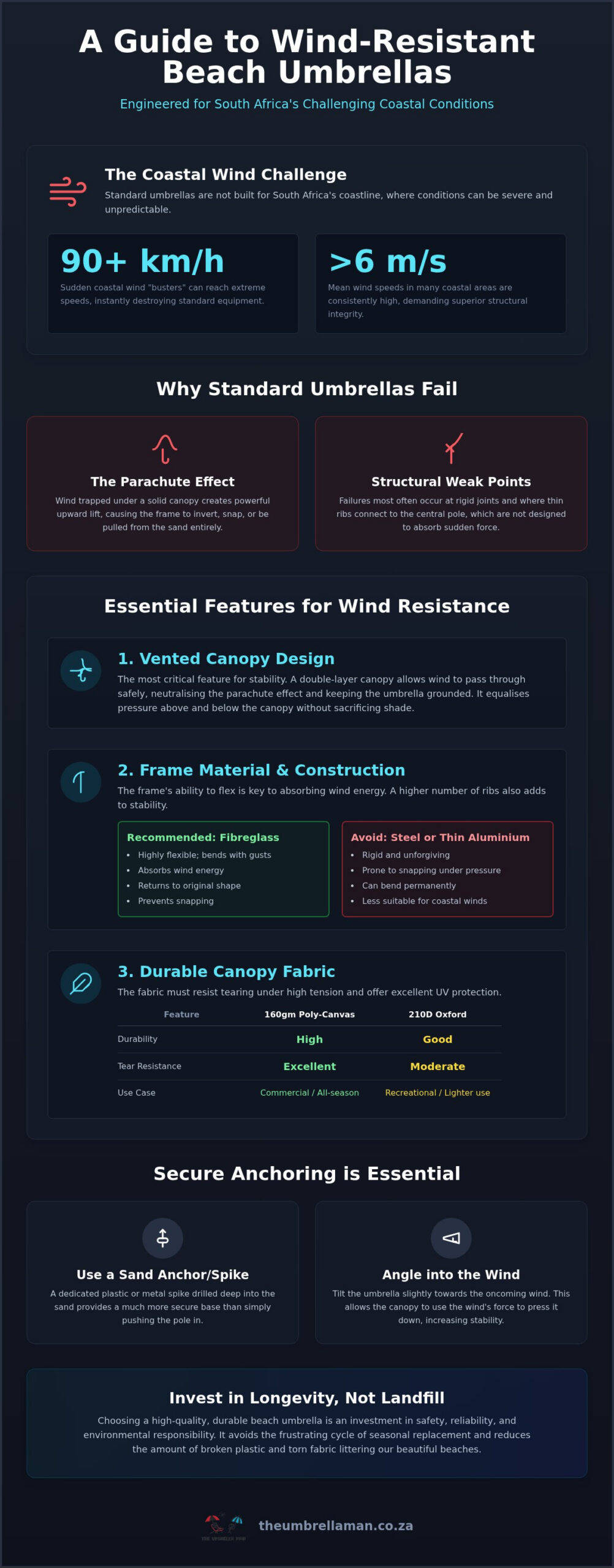
The South African coastline presents a formidable environment for outdoor equipment. With mean wind speeds in certain coastal areas reaching over 6 m/s and sudden gusts, known locally as “busters,” exceeding 90 km/h, the demand for a wind resistant beach umbrella South Africa can rely on is a necessity. Standard retail models are often designed for milder climates; they lack the structural reinforcements required to handle the persistent, multi-directional gusts found along our shores.
In a professional context, it’s vital to distinguish between windproof and wind resistant claims. No portable structure is entirely windproof against extreme gales. However, a wind resistant design focuses on managed airflow and structural flexibility. Professional-grade equipment is built to bend without breaking and to vent pressure rather than resisting it until a catastrophic failure occurs. This distinction is the difference between a product that lasts a single afternoon and one that serves for several seasons.
The Mechanics of Umbrella Failure
When a gust hits a standard canopy, it creates a parachute effect. The wind gets trapped underneath, creating upward lift that forces the frame to invert or lift out of the sand entirely. Most failures occur at the joints or where the ribs meet the central pole. Whilst a basic umbrella design serves well for light rain or garden use, beach conditions require higher tension and flexible ribs to absorb energy. Without these features, the canopy fabric often tears at the points of highest stress, rendering the umbrella useless.
Economic and Environmental Impact of Low-Quality Gear
Choosing disposable umbrellas leads to a frustrating cycle of seasonal replacement. This isn’t just an economic drain for families or hospitality businesses; it’s a significant environmental concern. Broken plastic frames and torn synthetic fabrics frequently end up as litter on our beaches. Investing in professional-grade gear, such as 160gm Poly-Canvas models, ensures longevity. It’s a more sustainable approach that reduces waste and provides a stable shade solution for many years. Quality equipment represents a long-term investment in both safety and environmental responsibility.
Key Features of a Wind Resistant Beach Umbrella Design
Engineering a stable shade solution for coastal environments requires a shift in perspective. Rather than attempting to resist wind through brute force, the most effective designs are those that manage airflow and energy absorption. A high-quality wind resistant beach umbrella South Africa needs must incorporate specific structural elements that prevent the common failures of inversion and frame snapping. It’s about how the structure handles pressure rather than just how much it weighs.
The Science of the Air-Vent
Standard canopies act like sails, trapping air and creating immense upward lift. A vented system solves this by allowing air to pass through the top of the umbrella without compromising shade coverage. An air-vented canopy acts as a dedicated pressure-release system for coastal winds. By equalising the pressure between the underside and the top of the fabric, the umbrella remains grounded even during sudden gusts. This airflow management is significantly more effective than simply increasing the weight of the base or the pole, as it addresses the root cause of instability.
Frame Flexibility and Resilience
The choice of frame material determines how the umbrella responds to stress. Whilst steel provides excellent rigidity for garden use, fibreglass is often the preferred choice for high-wind scenarios. Fibreglass ribs possess a natural flexibility that allows them to bend and absorb the energy of a gust, returning to their original shape once the pressure subsides. This flexibility is a hallmark of a premium wind resistant beach umbrella South Africa residents use to withstand coastal gusts. This resilience prevents the frame from snapping, a common issue with rigid plastic or thin-walled aluminium alternatives.
The stability of the canopy also depends on the rib count; a higher number of ribs provides more contact points for the fabric, maintaining the umbrella’s aerodynamic profile. Heavy-duty joints and tilt mechanisms are equally vital. These components are often the primary weak points where failure occurs. A robust design ensures these moving parts are reinforced to withstand lateral pressure. If you are looking for professional-grade specifications, exploring the range at theumbrellaman.co.za provides a clear benchmark for durable construction. Ultimately, a well-engineered umbrella prioritises structural integrity through a combination of flexible materials and intelligent airflow design.
Comparing Canopy Materials for Maximum Durability
Whilst the frame provides the structural skeleton, the canopy material serves as the primary shield against the elements. Selecting the right fabric is a technical decision based on density, weight, and protective coatings. In the context of a wind resistant beach umbrella South Africa residents can rely on, two primary metrics define durability: grams per square metre (gm) and Denier (D). These ratings indicate the thickness and weight of the weave, directly influencing how well the fabric resists tearing under high-pressure gusts.
Material choice also dictates how the umbrella handles the corrosive South African coastal environment. Salt-laden air and intense solar radiation can quickly degrade inferior fabrics, leading to colour fading and structural weakening. High-quality canopies are treated to maintain colour-fastness and resist the abrasive nature of wind-blown sand, ensuring the product remains professional in appearance over several seasons.
Poly-Canvas vs. Poly-Nylon
The 160gm Poly-Canvas is widely regarded as the superior choice for heavy-duty coastal use. Its dense weave provides exceptional tear resistance, which is vital when the canopy is under high tension from coastal winds. In contrast, 190T Poly-Nylon is a lighter alternative. Whilst nylon is highly portable and easy to transport, it lacks the sheer mass and “heft” of canvas. For hospitality sectors or commercial environments where a premium, established look is required, the 160gm Poly-Canvas offers a more robust and professional aesthetic that stays taut and stable on the sand. The same high-density fabric technology that excels on the beach is equally valued in garden umbrellas South Africa homeowners rely on to withstand summer storms.
UV Protection Standards in South Africa
Protection from the sun is just as critical as resistance to the wind. There is a direct correlation between fabric density and the ability to block harmful rays. A dense material like 210D Oxford fabric, specifically when equipped with a UV coating, provides an essential safety barrier for beachgoers. It’s a mistake to view UV protection as a secondary feature. A high-quality wind resistant beach umbrella South Africa conditions demand must offer a comprehensive solution that protects the user from both physical gusts and solar radiation. Using materials like the 1.85m 210D Oxford variant ensures that the shade provided is both cool and safe, meeting the rigorous demands of our local climate.
- 160gm Poly-Canvas: Best for high-stress environments and long-term durability.
- 210D Oxford with UV: Excellent balance of weight, wind resistance, and solar protection.
- 190T Poly-Nylon: A lightweight option best suited for short-term use or maximum portability.
Practical Tips for Securing Your Umbrella in High Winds
Even the highest quality wind resistant beach umbrella South Africa offers requires correct deployment to function effectively. Structural integrity is only half of the equation; the other half is how you anchor and position the equipment against the elements. Proper technique ensures that the umbrella works with the wind rather than fighting it, reducing the risk of damage to the frame or injury to bystanders.
Mastering the Sand Anchor
A standard pole pushed manually into the sand is rarely sufficient for coastal conditions. The use of a dedicated Plastic Umbrella Spike is essential for creating a stable foundation. This accessory provides the necessary grip by increasing the surface area within the sand, preventing the pole from wobbling or lifting. Once the spike is secured, you should bury the pole to a depth of at least 30 to 40 centimetres to ensure maximum stability.
Angling is the next critical step. You should always tilt the umbrella into the wind at approximately a 45-degree angle. This orientation ensures that the wind pressure pushes the canopy down towards the sand instead of getting trapped underneath it. By following this rule, you significantly reduce the upward lift that causes umbrellas to become airborne. If you need to upgrade your anchoring hardware, you can view our professional beach accessories here to ensure your setup is wind-ready.
Long-term Care and Maintenance
Coastal environments are notoriously harsh due to the combination of moisture and salt. Salt-heavy air can lead to corrosion on metal components and degradation of the fabric if left unmanaged. It is a professional standard to rinse your umbrella with fresh water after every beach visit. This simple action removes abrasive sand and corrosive salt, preserving the smooth operation of joints and tilt mechanisms.
Storage is equally important for longevity. You must ensure the canopy is completely dry before you organise its storage to prevent the growth of mould or mildew. Regularly checking for loose components or signs of wear amongst the ribs and joints allows you to address minor issues before they lead to structural failure. Whilst these products are built for durability, proactive maintenance is the key to ensuring they last for multiple summer seasons.
Safety should always be your priority. If gusts become so strong that the umbrella is visibly straining or if it becomes difficult to remain seated comfortably, it is time to close the canopy. Identifying these unsafe conditions prevents avoidable accidents and protects your investment from extreme weather events that exceed even professional-grade specifications.
Professional Sourcing for Durable Beach Umbrellas
Selecting a supplier for coastal equipment is a decision that impacts both safety and long-term costs. Since 2009, The Umbrella Man has operated as a specialist manufacturer and wholesaler, providing the expertise required to navigate the complexities of outdoor shade. By sourcing directly from a South African manufacturer, you ensure that the specifications of your wind resistant beach umbrella South Africa are tailored to our unique environmental pressures. This local manufacturing approach allows for better quality control and a deeper understanding of the materials that actually survive a coastal summer.
Bulk Orders and Commercial Solutions
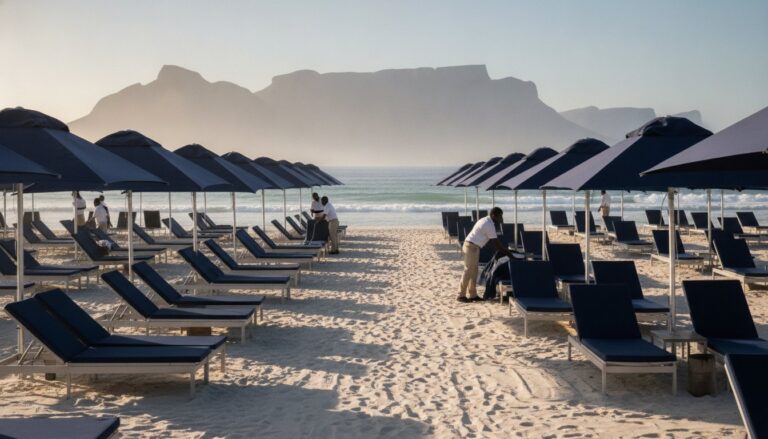
For high-traffic hospitality venues such as resorts and beachfront restaurants, the reliability of shade is a core component of the guest experience. We provide commercial-grade solutions that withstand the rigours of daily use in exposed environments. Choosing a locally based partner simplifies logistics and ensures that national supply requirements are met with consistent professional standards. If you are looking to integrate these durable structures into your corporate identity, our Custom Branded Umbrellas South Africa: The Professional Guide to Outdoor Visibility provides a detailed look at how to maintain brand presence whilst prioritising structural integrity.
Choosing the Right Model for Your Needs
Identifying the ideal model depends on your specific application and transport requirements. Selecting the correct wind resistant beach umbrella South Africa requires means weighing up portability against sheer durability. The 2.0m 160gm Poly-Canvas Beach Umbrella remains the standard for those prioritising maximum tear resistance and a traditional, robust appearance. Conversely, the 1.85m 210D Oxford Beach Umbrella with UV offers a more compact footprint with integrated solar protection, making it a versatile choice for various commercial sectors. To create a cohesive and professional outdoor environment, these models can be paired with our range of seating, such as the 7-Level Steel Beach Chair or the Low-Back Picnic Beach Chair.
Whether you are a promotional agency organising a large-scale event or a resort manager looking to upgrade your beachfront equipment, expert advice is essential. Our team is available to provide tailored guidance on bulk requirements, ensuring that your investment meets the necessary safety and durability benchmarks. It’s about building a partnership with a supplier that values consistency and transparency as much as you do. By choosing professional-grade equipment, you move away from the cycle of seasonal replacements and towards a stable, long-term solution for the South African coast.
Securing Long-Term Shade for the South African Coast
Selecting the specific wind resistant beach umbrella South Africa conditions require is a decision rooted in technical specification rather than simple aesthetics. We have explored how air-vented canopies and flexible frames work in tandem to manage coastal pressure, effectively preventing the common failures associated with standard retail gear. By prioritising high-density materials such as our 160gm Poly-Canvas, you ensure your investment withstands both high winds and intense UV radiation over multiple seasons.
The Umbrella Man has been a trusted South African manufacturer since 2009, specialising in high-performance solutions for the hospitality sector and individual users alike. Our established national supply chain ensures that reliable, commercial-grade equipment is accessible for both wholesale and retail requirements. Moving away from disposable seasonal purchases towards professional-grade hardware provides the stability and durability necessary for our unique environment.
Explore our range of professional beach umbrellas to find a durable shade solution tailored to your requirements. We look forward to helping you enjoy the South African coast with reliable, expert-engineered protection.
Frequently Asked Questions
What makes a beach umbrella wind resistant?
A wind resistant beach umbrella South Africa conditions require relies on structural flexibility and managed airflow rather than rigid resistance. Key components include an air-vented canopy that releases pressure and a frame made from resilient materials like fibreglass. These features allow the structure to absorb the energy of coastal gusts without inverting or snapping. High-tension fabric and reinforced joints also contribute to maintaining the umbrella’s aerodynamic profile during sudden weather shifts.
Is fibreglass better than steel for windy beaches in South Africa?
Fibreglass is generally superior for windy coastal environments because it possesses natural flexibility. Whilst steel is strong and rigid, it can snap or permanently bend when subjected to extreme lateral pressure. Fibreglass ribs can bend significantly under the force of a gust and return to their original shape once the wind subsides. This resilience makes it the preferred material for high-performance beach and golf umbrellas designed for South African conditions.
How do I stop my beach umbrella from blowing away?
Preventing an umbrella from lifting requires a combination of proper anchoring and strategic positioning. You should always use a dedicated Plastic Umbrella Spike to secure the pole deep into the sand, ideally to a depth of 40 centimetres. Additionally, tilting the canopy into the wind at a 45-degree angle ensures that pressure pushes the structure down rather than lifting it. Regularly checking the anchor’s stability throughout the day is also recommended.
What is the difference between Poly-Canvas and Oxford fabric?
The primary difference lies in the weight and weave of the material. 160gm Poly-Canvas is a heavy-duty fabric known for its exceptional tear resistance and professional, matte appearance. It’s ideal for high-stress coastal environments where durability is paramount. 210D Oxford fabric is typically lighter and often features a specialised UV coating. Whilst Oxford fabric provides excellent solar protection and portability, the Poly-Canvas variant offers greater mass and structural stability during sustained coastal breezes.
Does an air vent really help with wind resistance?
Yes, an air vent is one of the most critical features for stability. It acts as a pressure-release valve by allowing trapped air to escape through the top of the canopy. This reduces the parachute effect that causes umbrellas to lift or invert during sudden gusts. By equalising the pressure between the underside and the top of the fabric, a vented design ensures the umbrella remains grounded and structurally sound in high-wind scenarios.
Can I buy beach umbrellas in bulk for a South African business?
The Umbrella Man specialises in wholesale supply for businesses, resorts, and the hospitality sector across South Africa. We provide scalable solutions for commercial clients who require durable, wind resistant beach umbrella South Africa models in large volumes. Since we are a manufacturer established in 2009, we can accommodate bulk orders with consistent quality standards. Businesses can contact our team directly to discuss specific logistical requirements and volume-based procurement for their venues.
How long should a high-quality beach umbrella last?
A professional-grade beach umbrella should last for multiple summer seasons if maintained correctly. Durability depends on the quality of the materials, such as 160gm Poly-Canvas and reinforced frames, which resist the corrosive effects of salt air. To maximise longevity, you should rinse the equipment with fresh water after each use to remove abrasive sand and salt. Proper storage in a dry environment also prevents frame degradation and fabric mould over time.
Are these umbrellas suitable for branded promotional use?
These umbrellas are highly suitable for promotional use and corporate branding. Because they are built to commercial standards, they provide a long-lasting platform for outdoor visibility that won’t fail during events. Branding a high-quality wind resistant beach umbrella South Africa model ensures that your corporate identity is associated with reliability and professional standards. We offer customisation options that allow businesses to integrate their colours and logos onto durable fabrics like Poly-Canvas or Oxford.