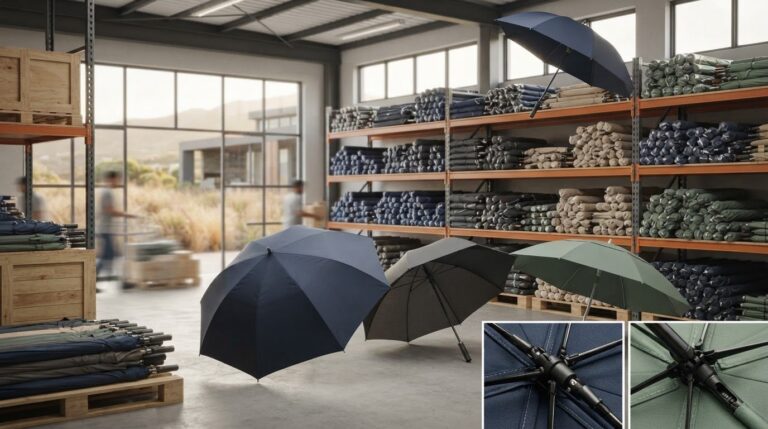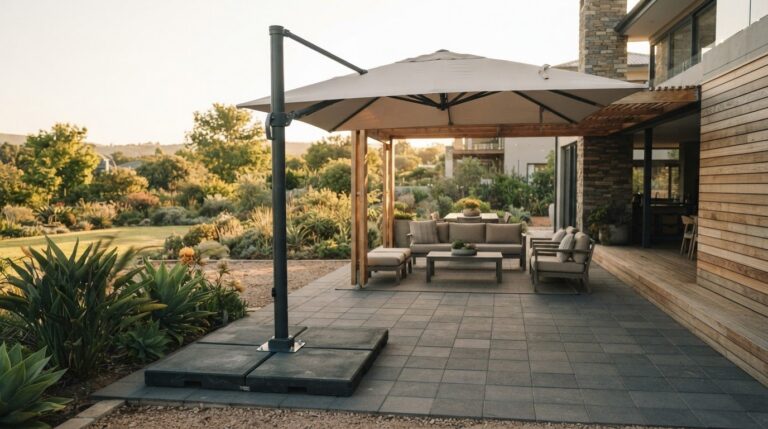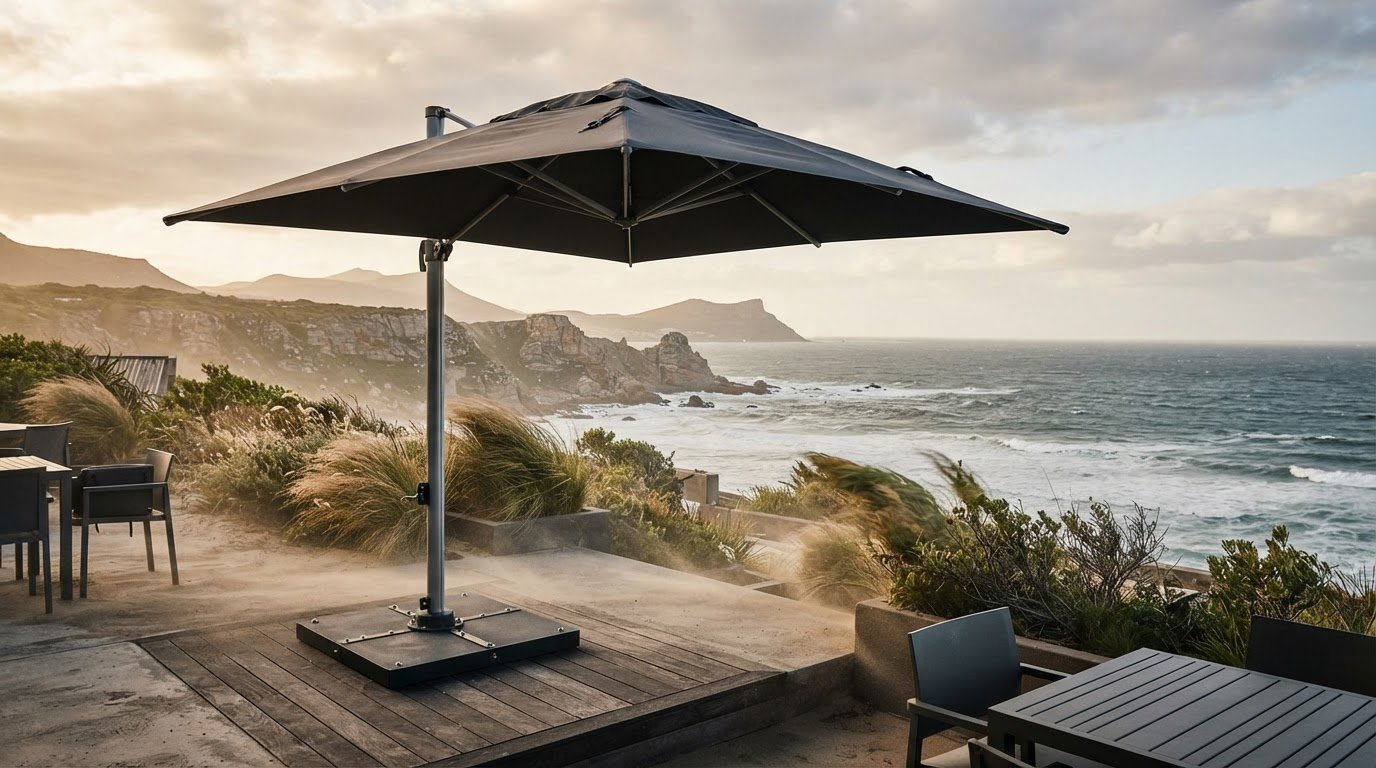
Commercial Parasol Wind Stability Guide 2026
A “wind-resistant” label alone can’t tell you whether an umbrella will stay stable on an exposed restaurant terrace or event site. This commercial umbrella wind stability guide starts with a more useful question: how will the complete setup perform where it will actually be used?
It’s reasonable to look for a clear wind rating, but stability isn’t determined by a canopy claim in isolation. Frame construction, umbrella size, base or anchoring, installation and site exposure all affect the decision. Buyers also need to distinguish stated operating limits from general marketing language, and plan how staff will respond as conditions change.
In this guide, you’ll compare the design, frame, canopy and base factors that shape stability, assess site conditions and identify the evidence worth requesting from suppliers. You’ll also find a practical enquiry checklist for confirming specifications, test documentation, installation requirements and operating guidance before purchasing. The aim is a clearer sourcing brief, not a blanket promise that any umbrella is windproof.
Key Takeaways
- Use this commercial umbrella wind stability guide to build a sourcing brief around the intended setting, product specifications and supporting evidence.
- Assess the canopy, frame, base and anchoring as connected parts of the setup, rather than treating any single feature as proof of stability.
- Compare supplier claims by asking what was tested, under which conditions and what operating limits apply.
- Survey the site for exposure, surface conditions, nearby structures, foot traffic, storage and supervision requirements before selecting an umbrella.
- Share intended use and quantities with suppliers, and confirm current specifications and suitability before making a commercial purchasing decision.
Commercial umbrella wind stability: what buyers need to assess first
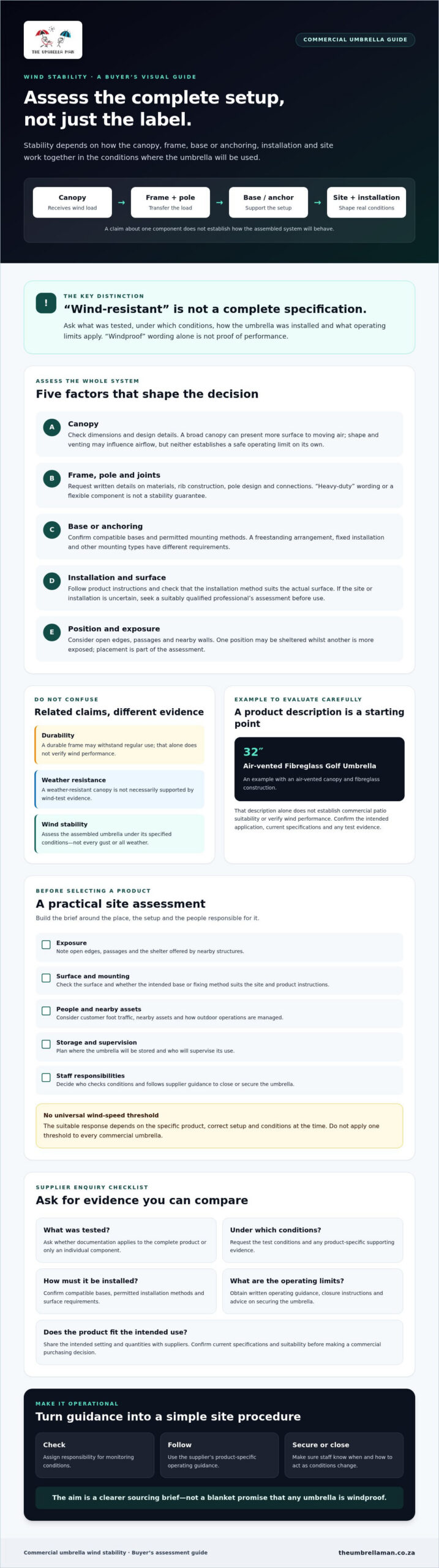
Wind stability can’t be judged from a product label alone. It describes how the complete umbrella setup performs in its intended conditions, including the canopy, frame, base or anchoring, installation and position on site. A claim about one component can’t establish how the assembled system will behave.
Wind exerts force on the canopy and transfers that load through the frame and pole to the base or anchor. The concept of wind load helps explain why the size and shape of a structure, as well as its surroundings, matter. Nearby walls may shelter one position, whilst an open edge or passage may expose another. Placement is part of the assessment, not an afterthought.
Keep stability distinct from durability and general weather resistance. A durable frame may withstand regular use, but that alone doesn’t verify its performance in wind. Likewise, a canopy described as weather-resistant isn’t necessarily supported by wind-test evidence. “Windproof” is not a complete purchasing specification: ask what was tested, how the umbrella was installed and what operating limits apply.
What does wind stability mean for a commercial umbrella?
For a buyer, stability means assessing the assembled umbrella’s ability to remain appropriately supported under its specified conditions. It isn’t a guarantee that the umbrella can withstand every gust or remain open in all weather. The canopy, frame, joints, pole, base and anchoring work together, and installation can change the outcome. Request product-specific operating and closure instructions, then make sure staff know when and how to secure or close the umbrella.
Why does stability matter in a business setting?
In a restaurant, accommodation venue or other customer-facing setting, an umbrella may be used repeatedly by different staff and customers. A clear plan helps protect people and nearby assets, and supports the continuity of outdoor operations. It also reduces reliance on someone interpreting a vague claim as conditions change.
Before purchasing, establish who is responsible for checking conditions, following the supplier’s guidance and closing or securing the umbrella. Record those responsibilities in a simple site procedure. Safe use depends on the specific product, correct setup and conditions at the time, so there’s no single wind-speed threshold that can be applied to every commercial umbrella.
How canopy, frame, base and anchoring affect umbrella stability
Assess each component as part of one setup. A broad canopy can present more surface to moving air, whilst its shape and venting may influence how air moves around it. These features can affect wind exposure, but they don’t establish a safe operating limit on their own. Ask the supplier for the canopy dimensions and design details, and request any product-specific test evidence rather than inferring performance from appearance.
The frame needs the same scrutiny. Material, rib construction, pole design and joints all influence how loads pass through the umbrella. A flexible component or a “heavy-duty” description isn’t a stability guarantee. For a useful comparison, request written specifications for the materials and connections, and check whether the supplier’s documentation applies to the complete product or only to an individual component.
How do canopy design and frame construction compare?
An air vent is a design feature, not proof of a wind rating. The Umbrella Man’s 32″ Air‑vented Fibreglass Golf Umbrella is one example of an umbrella with an air-vented canopy and fibreglass construction. That description alone doesn’t establish suitability as a commercial patio umbrella or verify its performance in wind. Confirm the intended application, current specifications and any test evidence before considering it for a particular use.
How should businesses assess bases and anchoring?
The base or anchor must suit the umbrella and the way it will be installed. A freestanding arrangement, a fixed installation and other mounting types have different requirements. Don’t select a base by weight alone or assume one option fits every canopy. Check the product instructions for compatible bases, permitted installation methods and operating guidance.
Also consider the surface. A base suitable for a firm, level area may not be appropriate on another surface, and an installation that relies on fixing into the ground needs to match the site and product instructions. If the installation method or site conditions are uncertain, seek a suitably qualified professional’s assessment before use.
- Ask what fits: Request compatible base or anchoring options for the exact umbrella model.
- Confirm the installation: Establish whether it is freestanding, fixed or intended for another mounting arrangement.
- Check the documentation: Obtain instructions covering setup, use and closure, and verify they apply to the proposed configuration.
Commercial buyers can share their application, quantities and specification questions with The Umbrella Man when assessing product fit. Make the site and installation requirements clear so the discussion can focus on the relevant product information.
Wind-resistant or windproof? Compare commercial umbrella claims carefully
“Windproof” isn’t a sufficient purchasing specification. It doesn’t tell you what conditions the umbrella was tested in, which components were included or whether the result applies to your site. Treat broad claims as prompts for questions, not evidence that an umbrella is suitable for every installation or weather event.
Use the approach in this commercial umbrella wind stability guide: compare each claim with the documentation behind it. Ask for a test report or written product specification, including the tested setup, conditions and stated operating limits. ASTM F3512 is identified as a test method for market umbrella wind safety and durability. If a supplier cites it, ask for documentation showing the test scope and configuration. A standard reference alone doesn’t establish suitability for your site.
What evidence should you request from a supplier?
Check whether a stated rating comes from a documented test, and request the report or supporting specification. Confirm whether testing covered the canopy, frame, base and installation method you intend to use. Then ask for written operating restrictions, closure instructions and any stated maintenance requirements. Evidence for a different base or mounting arrangement may not apply to your proposed setup.
| Claim wording | Supporting evidence to request | Test conditions to check | Use limits to confirm |
|---|---|---|---|
| “Windproof” | Specific test report or product documentation | Test method, configuration and conditions | Written operating and closure guidance |
| “Wind-resistant” | Defined performance claim and its evidence | Which components and installation were tested | Conditions outside the stated test scope |
| “Heavy-duty” or “weather-resistant” | Construction specifications and relevant test evidence | Whether the evidence relates to wind performance | Permitted use and care requirements |
Which comparison criteria matter beyond a wind claim?
Compare the frame and joint specifications, product instructions and information about replacement parts. Check that the supplier can explain how the documented product relates to your venue and expected pattern of use. Material names and descriptions such as “robust” may help describe construction, but they don’t prove tested wind performance.
Finally, separate product evidence from guarantees about a particular site. A test can describe performance under defined conditions; it can’t confirm that every installation, surface or weather event will match those conditions. Record what has been verified, what remains uncertain and which use limits staff must follow before approving a purchase.
A commercial umbrella wind stability checklist for your site
A site survey turns general product claims into practical purchasing requirements. Record how each proposed location is used, what surrounds it and how staff will manage the umbrella as conditions change. This commercial umbrella wind stability guide sets out a consistent process to help you assess locations and compare shortlisted options without relying on unsupported local wind figures.
What should a commercial site survey record?
- Map intended locations. Note where each umbrella will stand and whether it will serve a dining area, walkway, entrance or another space. Consider how people move around it and whether the open canopy could obstruct circulation.
- Describe exposure and surroundings. Record nearby buildings, walls, trees and other obstacles. Note where a position may be sheltered, exposed or affected by changing conditions, rather than assuming the whole site has the same exposure.
- Document the surface and installation. Identify the proposed surface and any practical limits on placing or securing a base. Match the options under consideration to the product instructions, and flag uncertain installation requirements for further assessment.
- Plan storage and inspections. State where umbrellas can be stored when not in use, who checks their condition and how often checks fit the site’s pattern of use. Include any instructions the supplier provides.
- Assign operating responsibilities. Name the roles responsible for opening, closing and securing umbrellas, and set out how staff should respond when conditions change. Keep the procedure accessible to everyone expected to follow it.
For beach locations, sand and anchoring raise specific questions. Consult this wind-resistant beach umbrella buyer’s guide for beach-specific considerations. Don’t assume beach guidance applies to a terrace or another commercial site.
How can buyers compare shortlisted umbrellas fairly?
Use the same questions for each option. This makes missing information easier to spot and helps you compare suitability for the actual venue, rather than being swayed by a single feature or broad claim.
- Specifications: Are the canopy, frame and joints described clearly?
- Documentation: Does any performance evidence cover the configuration being considered?
- Base and installation: Are compatible options and surface requirements stated?
- Operation: Are closure instructions and use limits provided in writing?
- Practical fit: Does the product suit the location, foot traffic, storage and supervision plan?
Resolve gaps before placing a bulk order. Share your intended application, quantities and outstanding specification questions when you discuss commercial umbrella requirements with The Umbrella Man, which supplies commercial buyers and bulk orders.
Choosing a supplier and product fit for commercial umbrella use
A clear supplier brief turns site requirements into questions a supplier can answer. This part of the commercial umbrella wind stability guide focuses on confirming product fit and documentation before committing to quantities, rather than relying on broad claims or assumptions about a product category.
What should a commercial umbrella supplier brief include?
Describe the intended venue and use, the quantity required, expected handling and storage arrangements, and any mounting needs identified during the site survey. Include details of the proposed surface and how staff will manage umbrellas as conditions change. The more specific the brief, the easier it is to identify gaps between the intended setup and the supplier’s product information.
Request current specifications, relevant test evidence and written instructions for installation, operation and closure. Ask which base or mounting arrangements are compatible, and whether the supplied evidence applies to that configuration. If a larger order is planned, ask how suitability can be confirmed before committing. Agree what information still needs verification, and keep the supplier’s answers with the purchasing record.
For broader planning, see this guide to commercial outdoor umbrella selection. For venues evaluating complementary weather protection such as outdoor blinds and awnings alongside umbrellas, you can learn more about QLD Shade to explore how structured shade systems are specified and installed. If branded umbrellas are part of the brief, custom branded umbrella guidance can inform that discussion. Branding needs should remain separate from checks on stability, installation and operating limits.
When might the confirmed golf umbrella be worth assessing?
The Umbrella Man’s confirmed offering includes a 32″ Air‑vented Fibreglass Golf Umbrella. Its name identifies an air-vented golf umbrella with fibreglass construction, but doesn’t establish a wind rating or suitability as a patio or fixed-shade product. Consider it only if its intended use aligns with your commercial application, then ask the supplier to confirm current specifications and provide any relevant performance evidence.
The Umbrella Man supplies commercial buyers and bulk orders. Share the application, quantities and specification questions, and confirm product suitability before purchasing. Discuss your commercial umbrella requirements with the supplier.
Turn your stability checks into a confident purchasing brief
A dependable commercial umbrella decision starts with the complete setup and the conditions at your site, not a “windproof” label. Compare the canopy, frame, base and anchoring together, and ask suppliers for evidence that applies to the proposed configuration. Then document who will operate, close and check each umbrella as conditions change.
Use this commercial umbrella wind stability guide to create a practical brief covering intended use, quantities, installation needs and operating guidance. The Umbrella Man is a South African umbrella supplier and manufacturer serving customers since 2009, including commercial customers and bulk buyers. Its offering includes the 32″ Air‑vented Fibreglass Golf Umbrella, which buyers can assess for a suitable application after confirming current specifications and intended use with the supplier.
Share your requirements and outstanding questions before making a purchasing decision. Discuss your commercial umbrella requirements with The Umbrella Man. Clear specifications and a site-specific operating plan can help you make a more informed choice for your business.
Frequently Asked Questions
Is a wind-resistant commercial umbrella the same as a windproof umbrella?
No. “Wind-resistant” and “windproof” aren’t interchangeable guarantees, and neither phrase alone tells you how an umbrella will perform at your venue. Ask for documented test evidence, including the tested canopy, frame, base and installation configuration, plus stated operating limits. Suitability depends on the complete setup and intended site conditions. Don’t assume a test result for one configuration applies to a different installation or every weather event.
How can I tell whether a commercial umbrella is stable enough for my venue?
Assess the canopy, frame, base, anchoring, installation surface and site exposure together. This commercial umbrella wind stability guide helps you identify what must be verified for the actual location, rather than relying on a single feature. Request product-specific specifications and setup, operating and closure instructions. Give the supplier details of your intended application and ask them to confirm whether the product and proposed configuration are suitable for it.
Do vented umbrellas perform better in windy conditions?
Not necessarily. Venting is a design feature that may influence how air moves through or around a canopy, but it doesn’t prove a particular wind rating or make an umbrella safe in every condition. Compare documented evidence for the specific product and configuration you’re considering. Check what was tested and under which conditions, then follow the manufacturer’s operating and closure instructions. Don’t treat the presence of a vent as a substitute for those checks.
What base should I use for a commercial outdoor umbrella?
Choose a base only after confirming it’s compatible with the umbrella and installation. The appropriate option depends on the umbrella design, mounting method, surface and supplier guidance, so there isn’t one base type or weight that suits every setup. Ask which bases are approved for the product and whether the instructions cover your proposed surface. Confirm the complete configuration before installation, and seek a professional assessment if site or fixing requirements are uncertain.
Can a commercial umbrella be left open in strong wind?
Don’t assume a commercial umbrella can remain open in strong or changing conditions. Follow the product-specific closure instructions and establish a clear staff procedure for monitoring conditions and securing or closing the umbrella. Make sure the people responsible know what to do and where it will be stored when closed. There’s no universal wind-speed threshold that can safely be applied to every umbrella, installation and site, so follow the supplier’s guidance.
What should I ask a supplier before buying commercial umbrellas in bulk?
Request current product specifications, relevant test documentation and details of the configuration covered by that evidence. Ask which bases are compatible, what operating restrictions apply, and what care and closure guidance is provided. Describe the venue, installation surface, expected handling and storage arrangements, then ask the supplier to confirm suitability for that application. Before ordering in bulk, check that the quoted product matches the tested configuration and documentation you’ve received.
Is an air-vented fibreglass golf umbrella suitable for every commercial setting?
No. The 32″ Air‑vented Fibreglass Golf Umbrella is an offering, but its category and construction alone don’t establish suitability for every commercial use or provide a verified wind rating. Explain your intended application to the supplier and ask them to confirm the current specifications, relevant limitations and any supporting evidence. Consider whether the product is appropriate for your venue and use pattern before treating it as an option for a larger order.