Commercial Parasol Base Weight Requirements: A Practical Guide
Could the same canopy need a very different base simply because it stands alone rather than passing through a table? That’s why commercial parasol base weight requirements can’t be judged by canopy size alone. A general recommendation is a useful starting point, but overlooking the installation or site exposure can leave a parasol unstable.
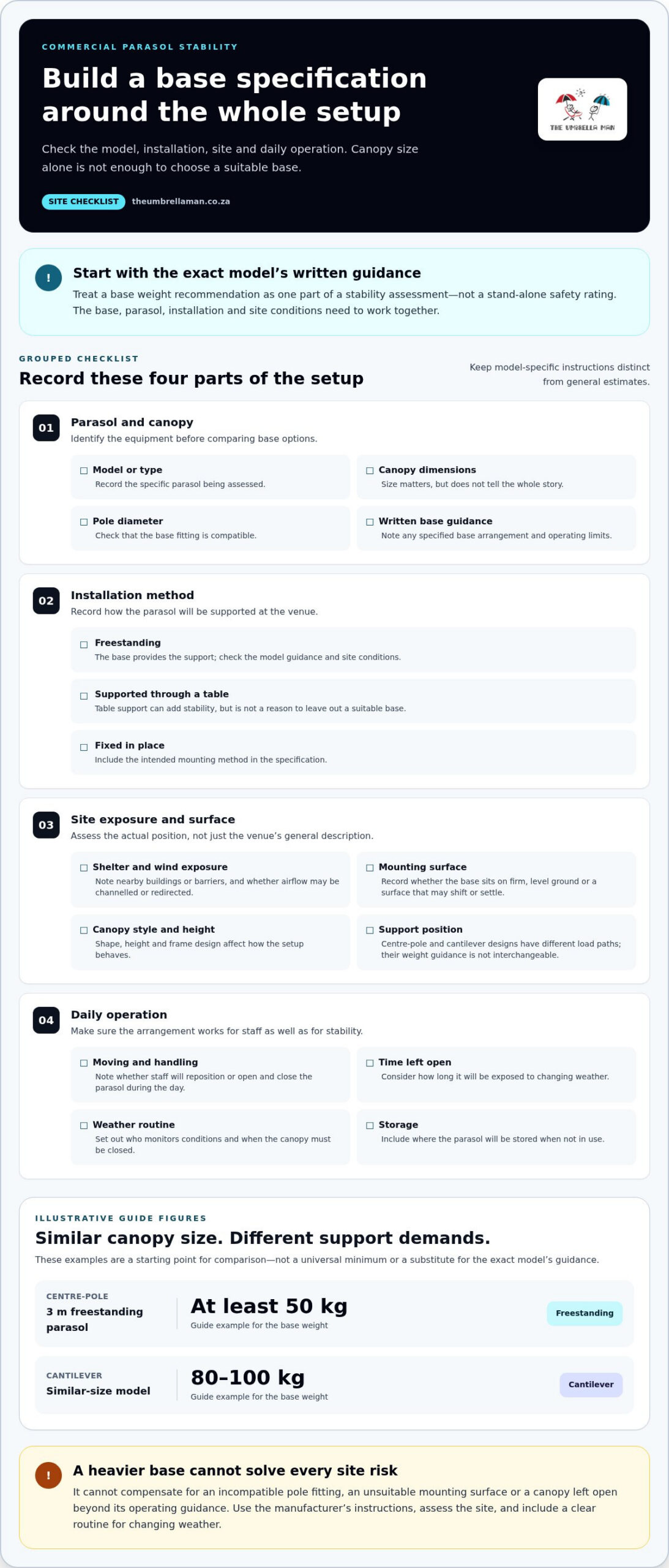
You’re right to want a clear figure before choosing equipment, particularly where guests, staff and property could be affected. As a guide, a 3m freestanding centre-pole parasol may need a base weighing at least 50kg, while a cantilever model of similar size may call for 80-100kg. These examples show how much the design and support method can change the decision.
This guide explains how canopy dimensions, wind exposure and surface conditions affect base selection, then compares freestanding, table-supported and fixed installations. It also covers practical checks for pole compatibility, securing the parasol and managing it in changing weather. Use the guidance to assess commercial options and create a specification and operating checklist suited to your site.
Key Takeaways
- Assess commercial parasol base weight requirements using the exact parasol model’s written guidance, then account for conditions at your site.
- Compare centre-pole and cantilever designs separately, as canopy shape and support position affect the forces acting on each parasol.
- Treat table support as an added source of stability, not a reason to leave out a suitable base.
- Check pole and base compatibility, the mounting surface and wind exposure before deciding how much ballast the setup needs.
- Include moving and storage in your plan so the chosen arrangement works for daily operations as well as stability.
What commercial parasol base weight requirements actually mean
A base weight recommendation is one part of a stability assessment, not a stand-alone safety rating. The base must work with the parasol’s frame and canopy, its installation method and conditions at the site. A heavy base cannot compensate for an incompatible pole fitting, an unsuitable mounting surface or a canopy left open in conditions beyond its operating guidance. Treat commercial parasol base weight requirements as a specification for a complete setup, not a number to select in isolation.
Commercial use brings practical considerations. Staff may open, close or reposition parasols as part of routine work, while guests move around the shaded area and furniture is rearranged. A parasol left open for long periods is exposed to changing weather for longer than one put up occasionally at home. Wind creates pressure on the canopy and frame. The concept of wind load helps explain why exposure and canopy area matter alongside the base itself.
Base choice depends on the parasol, installation and exposure together. A venue may set its own requirements to suit its layout and operating procedures, but that does not make one weight a universal minimum. Nor should a general rule of thumb be treated as a legal standard. Start with the manufacturer’s written guidance for the exact model, then assess how the equipment will be used at the venue.
Why commercial settings need a different assessment
Residential and commercial parasols can face similar physical forces, but their patterns of use may differ. A venue needs to account for repeated staff handling, guest circulation and how long the canopy remains open. If a parasol shifts or tips, it could strike someone, obstruct a walkway, damage nearby furniture or interrupt service. Considering these everyday risks makes the decision more useful than relying on a headline weight alone.
Which details belong in the base specification?
Record the equipment and its intended use before comparing base options. Keep manufacturer guidance distinct from general estimates, and document site conditions that could affect stability. A useful specification includes:
- Parasol details: model or type, canopy dimensions, pole diameter and any stated base guidance.
- Installation: whether it will be freestanding, supported through a table or fixed in place.
- Site exposure: surrounding shelter, likely wind exposure and the surface beneath the base.
- Operation: whether staff will move it during the day, how long it will stay open and where it will be stored when not in use.
These details give a venue a consistent basis for comparing options and planning daily use. They also show where the manufacturer’s model-specific instructions should take precedence over a broad rule of thumb.
How parasol design and wind exposure affect the weight needed
Base weight has to counter the forces acting on the whole parasol. A canopy catches moving air, while the pole and frame transfer that force to the base or mounting point. Canopy dimensions matter, but they don’t tell the full story: shape, height, frame design and support method all affect how the setup behaves. Assess commercial parasol base weight requirements for the specific model and position, rather than calculating them from canopy size alone.
How canopy size and parasol style change the stability question
A larger canopy presents more area to the wind, which can increase the force acting on the frame and its support. Its shape and height also influence how air moves around it. A centre-pole parasol has a pole positioned beneath the canopy. A cantilever design holds the canopy to one side, creating a different load path and placing different demands on the base. Weight recommendations for the two styles aren’t interchangeable, even when the canopies appear similar in size.
Use the manufacturer’s written guidance for the exact model, including any specified base arrangement and operating limits. General rules of thumb can help with an initial comparison, but they can’t account for every frame, canopy or installation. Don’t apply a figure for one design to another without evidence that it is suitable.
How site exposure and operating conditions affect the assessment
Assess the actual position, not just the venue’s general description. A sheltered courtyard may have nearby buildings or barriers that reduce direct exposure, while an open terrace can leave the canopy more exposed. Surrounding structures can also channel or redirect airflow, so shelter in one direction doesn’t necessarily protect the parasol from every direction.
Height matters because the canopy’s position affects its exposure, while the ground beneath the base affects how securely the setup sits. A firm, level surface differs from grass, sand or another surface that may shift or settle. Include these conditions in the assessment rather than trying to compensate for them with an unsupported weight calculation.
More ballast cannot make every parasol suitable for every wind condition. Follow the model’s operating guidance and include a clear routine for closing the canopy when conditions exceed its stated limits. Staff should know who is responsible for monitoring conditions and taking action. Leaving an open parasol unattended can turn a change in weather into an operational risk.
For a practical comparison, record canopy size and style first, then note the mounting surface, nearby shelter, exposure and usual operating pattern. Keep the manufacturer’s guidance alongside these site observations so the decision reflects the actual setup. Businesses planning broader umbrella requirements can also review business and bulk umbrella sourcing as part of their purchasing plan.
Commercial parasol base options compared: ballast, table support and fixed mounting
The right arrangement depends on whether the parasol must stand independently, work alongside a table or stay in one planned position. Each option contributes to stability differently and creates practical trade-offs for moving, storing and managing the equipment. Comparing them helps turn commercial parasol base weight requirements into a site-specific decision, rather than a choice based on one headline figure.
| Arrangement | Stability contribution | Mobility | Key limitations |
|---|---|---|---|
| Freestanding ballast | Provides the primary support at the pole base. | May be repositioned, depending on its design and weight. | Must suit the parasol, pole and site; heavy ballast can be difficult to move or store. |
| Table-supported centre pole | A suitable table can add support around the pole, alongside the base. | Relies on the parasol and table staying correctly positioned together. | Table strength, pole fit and placement all matter; table support does not automatically replace ballast. |
| Cantilever base | Supports an offset canopy and its distinct load arrangement. | Some setups may be moved, but the base still needs to remain securely positioned. | Specifications for centre-pole parasols cannot be assumed to apply. |
| Fixed or in-ground mounting | Anchors the parasol at a planned position rather than relying only on movable ballast. | Not intended for routine repositioning. | Requires suitable site planning and an appropriate installation surface. |
Freestanding and table-supported centre-pole arrangements
Freestanding ballast must support the parasol without relying on surrounding furniture. Passing a centre pole through a suitable table adds another stabilising factor, but the table needs to be strong, correctly fitted around the pole and positioned as intended. A table that shifts, is moved away or does not suit the pole should not be counted as dependable support. The parasol maker’s written guidance takes precedence over generic weight examples.
As a guide, a 3m freestanding centre-pole parasol may need a base weighing at least 50kg. Treat this as an example, not a universal minimum or legal standard. It does not establish the right specification for a different model, table arrangement or exposed site.
Cantilever, mobile and fixed base arrangements
A cantilever canopy sits away from its support point, so its base specification differs from that of a centre-pole design. A 3m cantilever parasol may call for an 80-100kg base. This is an example, not a blanket requirement; use the exact model’s instructions and intended installation to assess suitability.
Wheels or other mobility features can make a base easier to reposition, but movement must be managed so the parasol is securely positioned during use. Fixed and in-ground options avoid routine movement, yet require advance planning around the surface, placement and intended use. Businesses arranging umbrella supply separately from base selection can explore commercial umbrella sourcing as part of their wider purchasing plan.
How to assess commercial parasol base weight requirements step by step
A repeatable assessment helps staff and decision-makers compare base options on the same terms. Begin with the parasol’s instructions, then add details about the site and how the equipment will be used. This keeps commercial parasol base weight requirements tied to the actual setup rather than a generic figure.
A practical checklist before selecting a base
Gather the information in order. If you’re assessing several parasols, complete a separate record for each model and position. Differences in canopy, pole or placement can change which base arrangement is suitable.
- Identify the exact parasol model. Record its type, canopy dimensions and the manufacturer’s written guidance for base weight, installation and use. Keep any operating limits with the specification.
- Check base compatibility. Compare the pole diameter with the base sleeve or fitting, and note how the pole is secured. A base that is heavy enough still needs to fit the parasol correctly.
- Describe the installation. State whether the parasol will be freestanding, pass through a table or use a fixed mounting. For a table-supported setup, include the table’s position and whether it will stay there during use.
- Assess the surface and exposure. Record whether the base sits on paving, decking, grass or another surface, and note nearby buildings, barriers and open areas that may affect exposure.
- Plan movement and storage. Establish whether staff need to move the base, where it will be placed during use and where the parasol and base will be stored when not deployed.
- Compare options against the model guidance. Check the proposed base arrangement and ballast against the manufacturer’s recommendation, then document why it suits the site. Don’t substitute a generic weight example for model-specific instructions.
Beach anchoring is a different use case from supporting a commercial parasol on a venue surface. A wind-resistant beach umbrella guide can help with beach umbrella selection, but methods suited to sand should not be treated as a specification for a commercial parasol base.
Set clear operating rules for changing weather
A suitable base is only one part of day-to-day control. Write down who monitors conditions, who decides when parasols must be closed and how staff will secure and store them. Use the manufacturer’s limits alongside venue procedures, without assuming one wind-speed threshold applies to every model or site.
Make the routine practical: staff should know how to close the canopy, where it goes afterwards and how to keep it clear of guest routes. Additional ballast isn’t a substitute for closing a parasol when its guidance or venue procedure says to do so. For business umbrella sourcing beyond the base assessment, explore umbrella options for your business.
From base requirements to a dependable commercial umbrella plan
A dependable plan brings the parasol, base arrangement, site conditions and daily operating routine into one documented specification. Match the ballast and support method to the exact parasol and its installation, rather than treating a weight figure as a stand-alone decision. Base assessment and umbrella purchasing are related but separate decisions, so keep each requirement clear in your procurement plan.
Turn the assessment into a procurement specification
Before comparing options, record the model, canopy dimensions, pole details and intended position. Note whether the parasol will be freestanding, table-supported or fixed, as well as the surface, exposure and whether staff need to reposition it. Include the manufacturer’s written weight recommendation and operating guidance so the rationale remains clear.
Keep this record accessible to the people responsible for purchasing and daily operation. If a parasol is moved to a different part of the venue, reassess the conditions rather than assuming the original specification applies everywhere. For wider site planning, the commercial outdoor shade selection guide can help place umbrella decisions alongside other considerations for outdoor areas.
Explore umbrella supply for commercial requirements
Once the base and operating requirements are documented, use them to guide the umbrella sourcing decision. Compare products according to their intended setting and the written specifications available for each model. This keeps the equipment choice aligned with the venue’s needs, without confusing parasol selection with the separate assessment of its base.
The Umbrella Man manufactures and supplies umbrellas and outdoor products in South Africa, with options for individual and bulk orders. Its range includes golf, rain and beach umbrellas, as well as other outdoor products. Match your product selection to the intended setting, and assess the base separately against the specific parasol and site.
To continue your procurement planning, explore The Umbrella Man’s umbrella and outdoor products alongside your documented site requirements.
Put your outdoor procurement plan into action
Use your site assessment as a working brief for the next purchasing decision. Record the location, intended use and operating responsibilities alongside the parasol specification, so the people selecting equipment and those managing it day to day share the same information. This gives your team a practical basis for planning future additions or changes to the outdoor space.
Keep parasol sourcing separate from base selection. The right umbrella for your business should suit its setting and intended use, while the base arrangement must be assessed against that specific model and site. Treating these as connected but distinct decisions makes commercial parasol base weight requirements easier to apply consistently, without assuming one choice automatically resolves the other.
For your next step, explore options that can support your wider outdoor plans. Explore The Umbrella Man’s umbrella and outdoor products as you develop a considered procurement plan for your business.
Frequently Asked Questions
How heavy should a commercial parasol base be?
There isn’t one base weight that suits every commercial parasol. Start with the exact model’s instructions, then assess how it will be installed and used at the venue. For example, two parasols with similar canopy dimensions may need different arrangements if one is freestanding and the other is supported through a table. Treat general figures as comparison points, not guarantees. Record the chosen specification so staff can refer to it if the setup changes.
Does a larger parasol always need a heavier base?
No. A larger canopy can catch more wind, but size alone doesn’t determine the suitable base. A smaller parasol in an exposed position may present different operational concerns from a larger one in a sheltered setting. Compare the complete setup, including design and support method, with the model’s instructions. If a venue has several parasol types, assess each separately rather than applying the largest canopy’s recommendation to every unit.
Can a table replace a parasol base?
Not automatically. A suitable table may add support, but it doesn’t establish that the parasol can be used without a base. Check that the pole fits the table opening as intended and that the table stays in position during service. If staff regularly rearrange tables, the support arrangement may change during the day. Keep the parasol’s instructions with the operating procedure so staff know how it should be set up after furniture moves.
Is a heavier parasol base always safer?
No. More weight alone can’t make an unsuitable parasol, base or location safe in every condition. The base must work with the model and installation, and staff still need to follow operating instructions. A venue should not keep a canopy open simply because its base feels substantial. Set a clear process for closing and securing it when advised, and make sure relevant staff know where it is stored afterwards.
Do cantilever parasols need different base weight requirements?
They can, because an offset canopy places support demands differently from a centre-pole design. A figure given for a cantilever model should not be transferred to a centre-pole parasol, or vice versa. An 80-100kg base may be suggested for some 3m cantilever parasols, but that is not a universal specification. Use the instructions for the exact model and retain them with the venue’s purchasing and operating records.
Should commercial parasols stay open in strong wind if the base is heavy?
No. A heavy base doesn’t remove the need to close a parasol when conditions exceed its operating guidance. The venue should assign responsibility for monitoring conditions and ensure there’s a clear method for closing, securing and storing the canopy. This matters particularly during busy service, when staff may be occupied elsewhere. Make the procedure easy to follow and include it in staff handovers so responsibility isn’t assumed to belong to someone else.
What information should I gather before choosing a commercial parasol base?
Record the exact parasol model, canopy size, pole details, installation method and the manufacturer’s base guidance. Add the intended position, surface, nearby layout and whether staff need to move the base. Also document where the parasol will be stored and who will manage it in unsuitable conditions. This information helps distinguish one site setup from another and gives the purchasing team a consistent record for comparing options or replacing equipment.