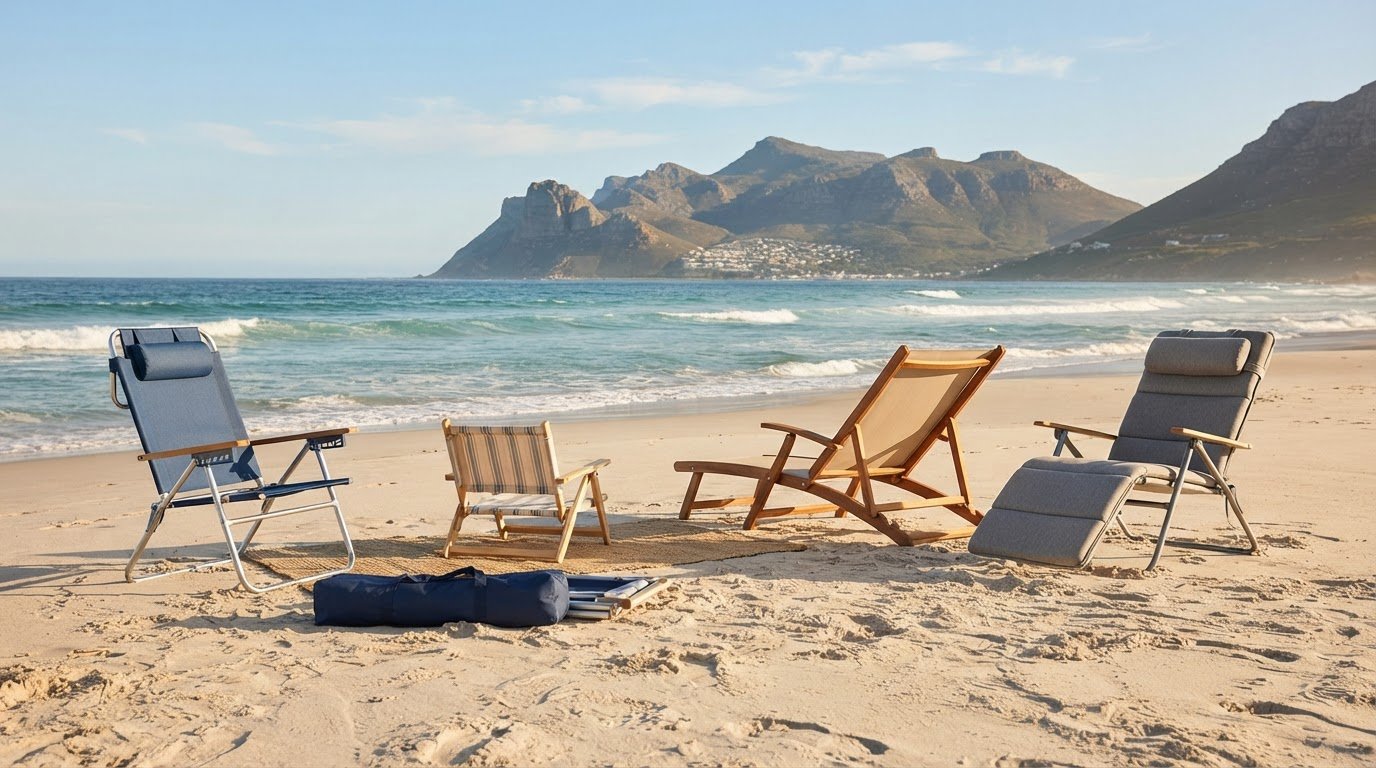
Beach Chair Buying Guide: Choose the Right Chair for You
The most suitable beach chaire depends on where and how it will be used, not simply on how it looks. A chair for occasional beach visits may not suit a retailer’s range or a hospitality setting where seating is used repeatedly. Comfort matters, but portability, seating style and intended use should also shape your choice.
This guide compares chair categories and offers a practical checklist for choosing one. It covers the 7-Level Steel Beach Chair, Low-Back Picnic Beach Chair, Wooden Beach Recliner and RIO Recliner Chair, each a different option to consider for personal leisure or commercial sourcing.
The Umbrella Man supplies outdoor products across South Africa, including chairs for retailers, businesses and hospitality clients. Read on to match a chair category to its likely setting, clarify what to consider before buying or sourcing, and distinguish an occasional-use choice from seating for a commercial environment.
Key Takeaways
- Match a beach chaire to its setting and expected frequency of use rather than choosing by appearance alone.
- Compare steel, low-back and recliner options by seating style, handling and storage needs.
- Use the checklist to clarify your requirements before buying for leisure or sourcing for retail and hospitality.
- Consider the 7-Level Steel Beach Chair, Low-Back Picnic Beach Chair, Wooden Beach Recliner and RIO Recliner Chair as distinct options for different needs.
Start with the setting: what should a beach chair do for you?
A chair for an occasional beach outing has a different job from seating for a picnic area, retail assortment or hospitality venue. Start by considering where it will be used, how long people are likely to sit, and how often it will be needed. These points help you decide whether carrying, seating style or use in a shared venue should take priority.
Choose a chair for the way it will be used, not simply for the place it will be used.
A beach chair is intended for outdoor leisure, but that broad purpose covers different designs. A deckchair is one familiar type; for context on the history and types of deckchairs, including variations in their form, see Wikipedia. For buyers, the key point is that a chair’s category alone does not determine whether it suits a particular setting.
Which settings call for different beach chair priorities?
At the beach, consider how the chair will be carried from the vehicle or drop-off point to your spot, and whether it will need to be moved during the day. For a picnic, think about how it will fit alongside other items being transported and whether its seating style suits an informal arrangement. In a garden or outdoor venue, the chair may be closer to storage, so moving and putting it away could matter more than carrying it over a distance.
Consider how long people are likely to sit, too. A brief rest between activities may call for a different seating style from an occasion where guests will remain seated for longer. Portability and seating style are separate considerations: a preferred way of sitting does not automatically tell you how easy a chair is to transport or store.
Personal choice or business sourcing: what changes?
For personal leisure, start with your routine. Do you take a chair to the beach, use it for picnics, or move between outdoor locations? Consider who will carry it, where it will be stored and which seating style suits those activities. A beach chaire that fits your usual routine is more practical than one chosen for a feature you rarely need.
Retailers have a different task: selecting an assortment for customers with varied settings and preferences. A range of chair categories can help distinguish between beach, picnic and reclining use without presenting one option as right for everyone.
For hospitality buyers and event organisers, consider how guests will use the seating, where it will be set out, and how often it will be moved, stored and brought back into use. The planned use and handling are better starting points than assumptions about durability. Define those needs first, then compare suitable categories.
Beach chair styles explained: from steel seats to recliners
Beach chair describes several designs. Some categories refer to seating shape, while others identify a material or reclining style. Recognising the difference helps you compare options without assuming that every chair in a category has the same construction or features.
The Umbrella Man’s range includes the 7-Level Steel Beach Chair, Low-Back Picnic Beach Chair and two recliner options: the Wooden Beach Recliner and RIO Recliner Chair. Their names are a useful first guide to the categories. Your setting and handling needs help determine which options to consider.
How do low-back chairs, steel chairs and recliners differ?
A low-back chair is identified by its back style, a steel chair by the material named in its product title, and a recliner by its seating category. These names offer a starting point for comparison, but do not establish exact dimensions, frame construction or adjustment mechanisms. A low-back chair, steel chair and recliner are different categories, not interchangeable specifications.
Seating style may influence where you consider using a chair. For example, a low-back picnic chair may be shortlisted for a picnic, while a recliner may suit buyers looking for that seating category. The Wooden Beach Recliner and RIO Recliner Chair are both recliner options, but their names alone do not show that they share the same design or features.
For businesses sourcing outdoor furniture, it can also help to understand what product testing and certification may cover. UL provides information about UL safety standards for outdoor furniture. This provides context on testing, rather than information about the testing or certification status of a specific chair.
What should you know about folding and carrying?
Transport and storage are separate considerations from chair type. Before selecting a category, think about how the chair will travel to its use point, whether it needs to be carried between locations, and where it will be stored afterwards. For a venue, consider who will move and put away the seating. Use these questions to define what you need, then compare the product information for each option.
For further general context, look for Steel Beach Chairs in South Africa: A 2026 Professional Roundup alongside this guide. Compare chair categories with your requirements rather than assuming that “steel”, “low-back” or “recliner” describes portability.
Once you have identified the category that fits your intended use, explore The Umbrella Man’s beach chair range, including its steel, low-back and recliner options.
Compare beach chairs by use case, not by a single “best” label
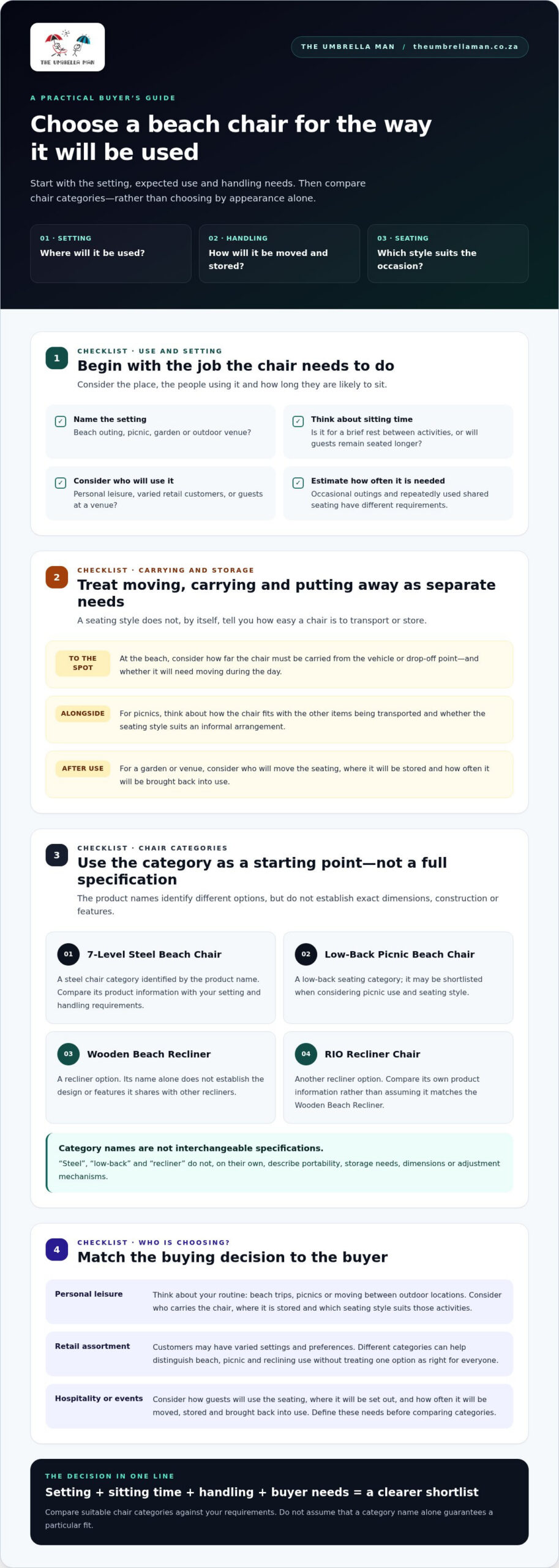
There is no single chair category for every buyer. A beach outing, picnic, outdoor venue and retail assortment each bring different priorities. Use the comparison below to narrow the options by setting, handling needs and who is making the decision. The categories are starting points, not guarantees of suitability.
| Setting | Useful chair category to consider | Handling needs to weigh up | Typical buyer |
|---|---|---|---|
| Beach leisure | Recliner category or steel chair category | How the chair will be carried to the spot, moved during the outing and stored afterwards | Individual or group sourcing for leisure use |
| Picnic | Low-back picnic chair | How it fits with other items being transported and the space available at the picnic spot | Personal buyer or group organiser |
| Outdoor venue | Chair category that suits the guests and venue layout | How chairs will be set out, moved between uses and stored | Hospitality or event buyer |
| Retail assortment | A selection across different chair categories | How stock can be organised and presented for varied customer preferences | Retailer |
Which chair category suits a beach outing or picnic?
For a picnic, the Low-Back Picnic Beach Chair is a relevant category to consider by name. For beach leisure, compare it with recliner options such as the Wooden Beach Recliner or RIO Recliner Chair, focusing on the seating type you prefer. Product names identify categories, but do not provide details such as carrying weight, folded size, recline settings or accessories.
Think through the outing from start to finish. A chair carried from a parking area has different handling considerations from one set out near a venue’s storage space. Consider the distance, who will carry it and where it will be kept between uses. A category may suit your seating preference but still need to be assessed against these practical needs.
What should retailers and hospitality buyers compare?
Retailers can use a variety of categories to serve customers with different plans and seating preferences, rather than presenting one style as the universal choice. A beach chaire assortment might include low-back, steel and recliner categories, with clear descriptions that explain the distinctions without adding unverified claims.
Hospitality and event buyers can start with their guests, venue layout and expected use. Consider whether seating stays in one place or needs to be moved and stored between events. If you are planning beach equipment alongside chairs, the Choosing the Best Wind Resistant Beach Umbrella in South Africa: 2026 Buyer’s Guide covers a related part of organising an outdoor setup.
Use this beach chair checklist before you buy or source
A clear brief makes it easier to compare chairs on relevant criteria instead of being distracted by features that may not matter for your use. Start with the setting, then consider seating style, transport and storage. Decide where the chair will be used before comparing product features.
A four-step checklist for personal beach chair selection
- Identify the setting and frequency. Note whether the chair is mainly for beach outings, picnics, the garden or another outdoor activity. Consider how often you expect to use it and whether it will stay in one place or travel with you.
- Choose a seating category. Decide whether a low-back style, steel chair or recliner category best matches the activity and your seating preference. Use product names to identify the category, and rely on product information for further details.
- Plan for carrying and storage. Consider who will move the chair, how far it may need to travel and where it will be kept between outings. Include any storage limits in your comparison rather than assuming how a chair folds or packs.
- Compare options against your priorities. Make a short list of what matters most, such as setting, seating style and handling. Apply the same criteria to each option so your choice reflects your routine, not just one appealing detail.
If you searched for a beach chaire, use your requirements to narrow the options, then compare the available product information against the questions you have identified.
A sourcing checklist for retail and hospitality teams
For commercial sourcing, define the intended users and context before choosing chair categories. A retailer may want an assortment that covers different customer preferences, while a hospitality team may need to consider venue layout, guest activities and how often seating is set out, moved or stored.
- Describe the use pattern. Record whether chairs are for a particular area, event or broader range, and how they are expected to be used.
- Set quantity needs. Estimate the number of chairs required for the planned assortment or venue. Base the estimate on your space and purchasing plan.
- Compare categories consistently. Consider the 7-Level Steel Beach Chair, Low-Back Picnic Beach Chair, Wooden Beach Recliner and RIO Recliner Chair by their named categories and how these fit your requirements.
- Review handling and storage. Include the people responsible for moving and storing the chairs, as well as the space available for those tasks.
Once your checklist is clear, explore The Umbrella Man’s outdoor chair range and compare its chair categories with your personal, retail or hospitality requirements.
Explore The Umbrella Man beach chair range for your requirements
The Umbrella Man supplies umbrellas and outdoor products across South Africa. Its chair range includes several categories for retailers, hospitality teams and other buyers to consider for different outdoor settings. Instead of treating one chair as a universal choice, match its category to the people who will use it and the context in which it will be used.
Which confirmed chair options should readers explore?
The range includes the 7-Level Steel Beach Chair and Low-Back Picnic Beach Chair, as well as two recliner options: the Wooden Beach Recliner and the RIO Recliner Chair. Their names point to different categories. Use product information to compare details such as dimensions, portability, materials and other features.
For personal leisure, the names can help you decide whether to consider a steel chair, a low-back picnic chair or a recliner. Retailers can use the range as a starting point for considering different customer preferences. Hospitality and event buyers can compare the categories with guest activities, venue layout and their approach to setting out and storing seating.
A use-led comparison is especially helpful when sourcing for a business. A retailer may be deciding which categories complement its existing outdoor assortment, while a hospitality team may be planning seating for a particular guest area. In both cases, product names help identify categories, while the buyer’s requirements guide the decision.
How can buyers take the next step?
Before selecting an option, summarise the purpose of the purchase in practical terms. A clear brief might include:
- Setting: where the chairs will be used, such as a picnic area, beach setting or outdoor venue.
- Users: who the seating is intended for, including guests or the customers represented in a retail assortment.
- Use pattern: how often the chairs are likely to be set out and whether they will be moved or stored between uses.
- Scope: whether the requirement is for an individual setting, retail selection or bulk business sourcing.
Once these points are clear, compare the 7-Level Steel Beach Chair, Low-Back Picnic Beach Chair, Wooden Beach Recliner and RIO Recliner Chair with the intended use. The Umbrella Man serves retailers, businesses and hospitality clients, so this category-led approach can make sourcing more focused.
For a practical next step, explore The Umbrella Man’s beach chair range and consider which options align with your requirements.
Turn your shortlist into a clear next step
Before choosing a beach chaire, turn your preferred option into a simple decision brief. Note where it will be used, who the intended users are, how frequently it will be needed, and what handling or storage arrangements apply. For retail and hospitality purchases, include the planned quantity and how the chairs will fit the wider outdoor offering or guest setting. A concise brief keeps the decision focused on practical requirements.
Separate essential criteria from preferences. Identify what the chair must suit, then note which qualities would be helpful but are not essential. This gives you a consistent way to assess options and makes trade-offs clearer, particularly when sourcing for a group or business.
The right choice is the one that makes sense for the way you plan to use or source it. Start with the chair category that matches your setting, then use your brief to guide the comparison.
Explore The Umbrella Man’s outdoor chair range and identify options that align with your needs. A clear starting point helps you make a considered choice.
Frequently Asked Questions
Is a beach chair suitable for camping?
It can be, provided the chair suits the campsite and the way you plan to travel. A chair carried from a vehicle to a pitch has different transport needs from one kept beside a campervan. Consider the planned activities, available storage space and whether the chair will be moved during the trip. Do not assume every beach chair is designed specifically for camping.
Can I use a beach chair in the garden or at an outdoor event?
A beach chair may work in a garden or at an outdoor event if its seating style suits the occasion. Think about the surface and layout, who is likely to sit in it and whether it must be cleared away afterwards. For a shared event, consider whether one chair category suits the guests or whether different seating styles would be more appropriate.
What should I look for in a beach chair?
Start with where the chair will be used and how often, then assess its seating category, transport and storage needs. A beach chaire for occasional outings may call for different considerations from chairs sourced for a venue. For business purchases, record who will use the chairs and how they will be handled. Compare stated product details rather than inferring features that are not described.
Are low-back beach chairs better than recliners?
Neither category is automatically better. The right choice depends on the activity and your seating preference. A low-back chair and a recliner describe different seating styles, so consider which is more appropriate for the setting. Someone choosing picnic seating, for instance, may prioritise a different category from a buyer planning a recliner-style seating area. Use each product’s stated information rather than assuming a particular adjustment or comfort feature.
How should a retailer choose beach chairs for an assortment?
Begin by defining the customers and outdoor activities the assortment should serve. A retailer may find it useful to consider separate categories for picnic use, beach leisure and reclining preferences. Then compare options using consistent criteria, including category and the details stated in each product listing. Clear descriptions help customers understand the differences without relying on assumptions about construction, dimensions or features.
What should hospitality businesses consider when sourcing beach chairs?
Hospitality buyers should map the intended seating areas, guest needs and expected use pattern before comparing options. Chairs for a poolside lounge area, for example, may serve a different purpose from seating for an occasional outdoor event. Consider how the venue will set out and store the chairs, and compare categories against practical requirements. Base decisions on stated product information rather than assumptions about lifespan or performance.
Does The Umbrella Man supply different types of beach chairs?
Yes. The Umbrella Man’s chair options include the 7-Level Steel Beach Chair, Low-Back Picnic Beach Chair, Wooden Beach Recliner and RIO Recliner Chair. The names identify different categories to consider. Compare the options with your intended use, whether you are sourcing for a retail assortment, hospitality setting or another outdoor requirement.