The 32-Inch Fibreglass Golf Umbrella: A Professional Sourcing Guide
A standard steel frame on an open South African fairway isn’t just an outdated piece of equipment; it’s an operational liability. Between relentless coastal winds, sudden inland squalls, and genuine lightning safety concerns, specifying a resilient fibreglass golf umbrella has shifted from an optional upgrade to an essential standard. If you manage procurement for golf clubs or corporate hospitality, you already recognise how quickly buckled ribs, inverted canopies, and unsightly coastal rust can compromise player comfort whilst damaging your professional reputation.
Discover why the 32-inch air-vented fibreglass design is the non-negotiable standard for professional golf and corporate events across South Africa. By pairing structural flexibility with aerodynamic pressure relief, this specification delivers lasting performance where conventional frames routinely fail. In this guide, we examine the mechanical thresholds, canopy engineering, and sourcing criteria you need to secure a reliable, long-lasting fleet that ensures player safety and protects your brand image.
Key Takeaways
- Understand the commercial distinction between rib radius and canopy arc, ensuring your selected fibreglass golf umbrella provides genuine coverage for two to three adults.
- Discover why composite frames offer superior coastal corrosion resistance and dielectric safety compared to traditional steel assemblies during volatile weather.
- Learn how dual-canopy aerodynamic pressure release prevents frame inversion and structural deformation under heavy wind conditions.
- Master the procurement criteria for tournament and hospitality fleets, including push-cart handle ergonomics and durable corporate branding placement.
What Defines a Professional Fibreglass Golf Umbrella?
Procurement teams often conflate promotional giveaways with tournament-grade sporting equipment. While low-cost variants satisfy basic handout requirements, they routinely buckle when subjected to actual fairway conditions. A true commercial fibreglass golf umbrella is engineered to withstand sustained environmental stress, offering structural resilience, calculated ergonomics, and expansive coverage that protects players alongside their equipment.
Over the past two decades, this hardware has naturally transitioned beyond the fairways. Prestigious hotels, corporate campuses, and automotive dealerships now deploy them as the standard for executive hospitality, where product failure directly impacts the client experience.
The 32-Inch Arc: Maximum Coverage Standards
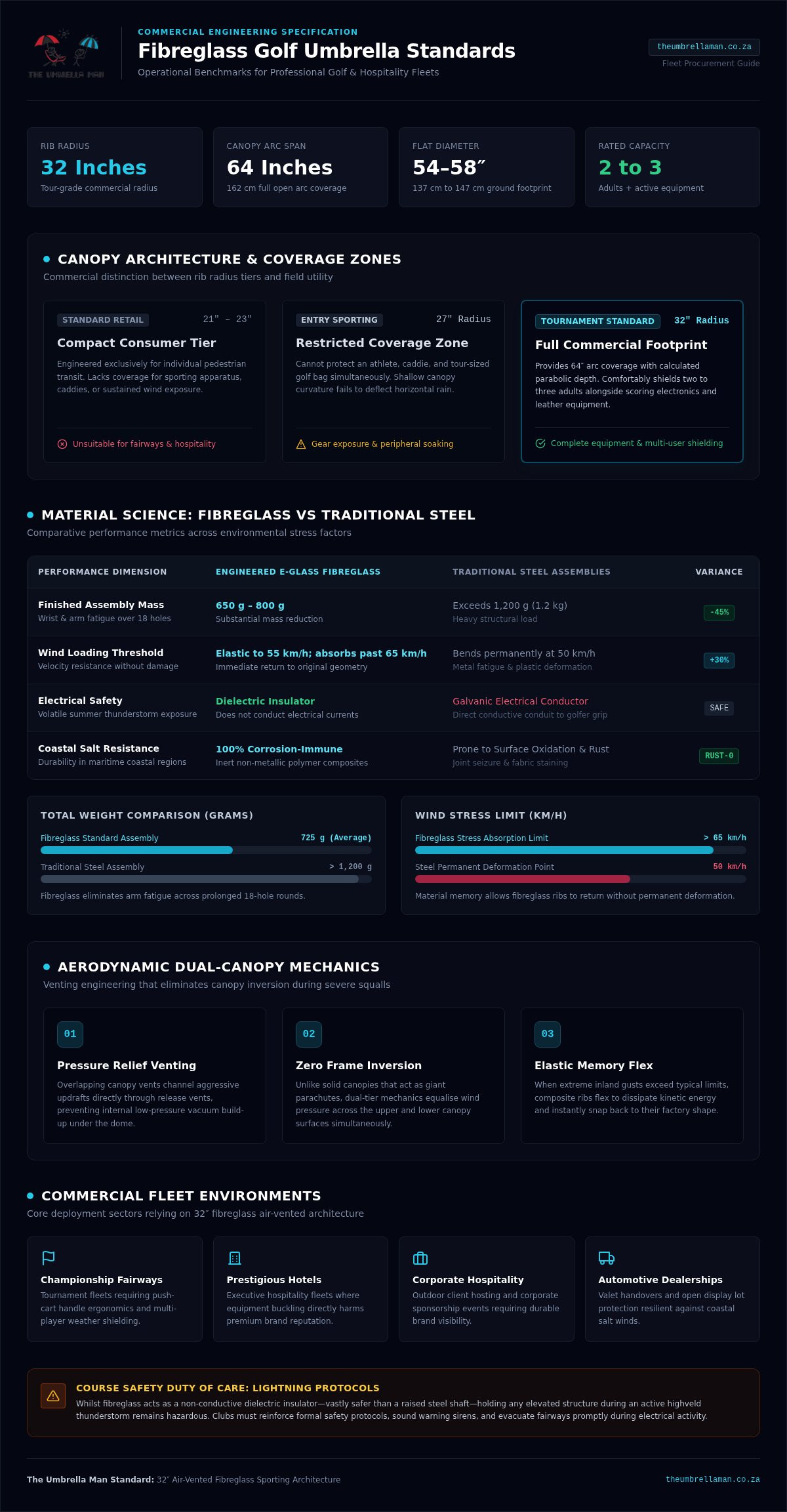
In commercial manufacturing, umbrella sizing causes frequent confusion. A 32-inch designation does not describe total width; it specifies the individual rib radius extending from the top notch to the canopy tip. This measurement produces an open arc of roughly 64 inches (162 cm) and a flat diameter spanning 54 to 58 inches (137 to 147 cm). According to standard umbrella specifications and sizing history, this specific architectural footprint provides genuine coverage for two to three adults.
Standard retail umbrellas typically feature 21-inch to 23-inch frames, whilst entry-level sporting models sit around 27 inches. These smaller dimensions fail in demanding sporting environments for clear functional reasons:
- Restricted coverage zones: A 27-inch canopy cannot protect an athlete, an active caddie, and a tour-sized golf bag simultaneously, inevitably soaking leather gear or sensitive scoring electronics.
- Shallow canopy depth: Smaller frames lack the parabolic curvature required to shed driving, horizontal rain away from the user’s periphery during severe squalls.
Why Fibreglass is the Preferred Professional Material
Frame composition dictates service life. Traditional steel frames add unnecessary mass, with a standard steel rib set pushing finished weights beyond 1.2 kilograms. By contrast, an engineered E-glass fibreglass frame reduces the finished assembly weight to between 650 and 800 grams. This substantial reduction prevents wrist and arm fatigue when carried across an 18-hole round or held through prolonged outdoor corporate presentations.
The fibreglass golf umbrella has served as the undisputed industry benchmark for sporting durability since the mid-2000s due to its remarkable material memory.
Under severe wind pressure, fibreglass flexes elastically. Whereas rigid steel ribs suffer irreversible plastic deformation or snap entirely when overloaded, composite fibreglass ribs bend with extreme gusts and return immediately to their original geometry without structural degradation.
Fibreglass vs Steel Frames: Performance and Safety
Specifying fleet umbrellas for sporting estates or commercial venues requires evaluating how materials behave under environmental strain. While traditional steel frames appear robust initially, their rigidity and metallic conductivity introduce functional weaknesses. An engineered fibreglass golf umbrella solves these vulnerabilities through composite material science, offering measurable advantages in user safety, mechanical memory, and operational longevity.
From an asset management perspective, the financial return is clear. Steel frames subjected to repeated loading suffer metal fatigue, bending permanently under wind pressures as low as 50 km/h. In contrast, fibreglass composites retain their structural elasticity up to 55 km/h and absorb stress past 65 km/h without buckling. This resilience dramatically reduces write-off rates, sparing corporate coordinators the recurring expense of replacing distorted equipment after a single tempestuous tournament.
Lightning Safety on the Fairway
South African summer afternoons frequently bring sudden, violent electrical activity across highveld fairways. Elevating a steel shaft during these abrupt weather shifts presents a severe hazard. Steel is an efficient electrical conductor, creating an attractive galvanic pathway between overhead cloud charges and the golfer holding the grip.
Fibreglass acts as a dielectric insulator, meaning it does not conduct electrical currents. While this non-conductive property significantly reduces the risk of carrying an overhead electrical conductor, golf committees must reinforce formal course safety protocols. As detailed in the National Weather Service lightning safety guidelines, holding any raised object across open fairways during an electrical storm remains unsafe, and clubs bear a duty of care to sound warning sirens and evacuate players immediately.
Durability in Harsh Environments
Regional climates place distinct pressures on hardware, especially along coastal stretches where airborne salt accelerated oxidation destroys metallic frames. Standard electroplated steel demonstrates up to 15% surface corrosion within 48 hours once its protective surface coating gets scratched by normal grit. Rust bleeds onto the canopy fabric, staining branded panels and freezing runner mechanisms.
Fibreglass completely avoids galvanic oxidation, remaining unaffected by humid marine air and persistent salt spray. While steel frames in high-humidity coastal zones routinely fail within a single season due to joint corrosion, inert fibreglass frames maintain complete structural integrity over multiple years of intensive outdoor service.
Sunlight poses an equal challenge. Continuous ultraviolet exposure bakes inferior polymers, causing unreinforced plastics to become brittle. High-grade composite frames incorporate UV-stabilised resins that resist solar degradation, ensuring ribs remain pliant rather than fracturing under wind loading. Facilities seeking a dependable equipment partner can explore commercial hardware from The Umbrella Man to establish a durable, weather-resistant fleet.
The Mechanics of Air-Vented Canopy Designs
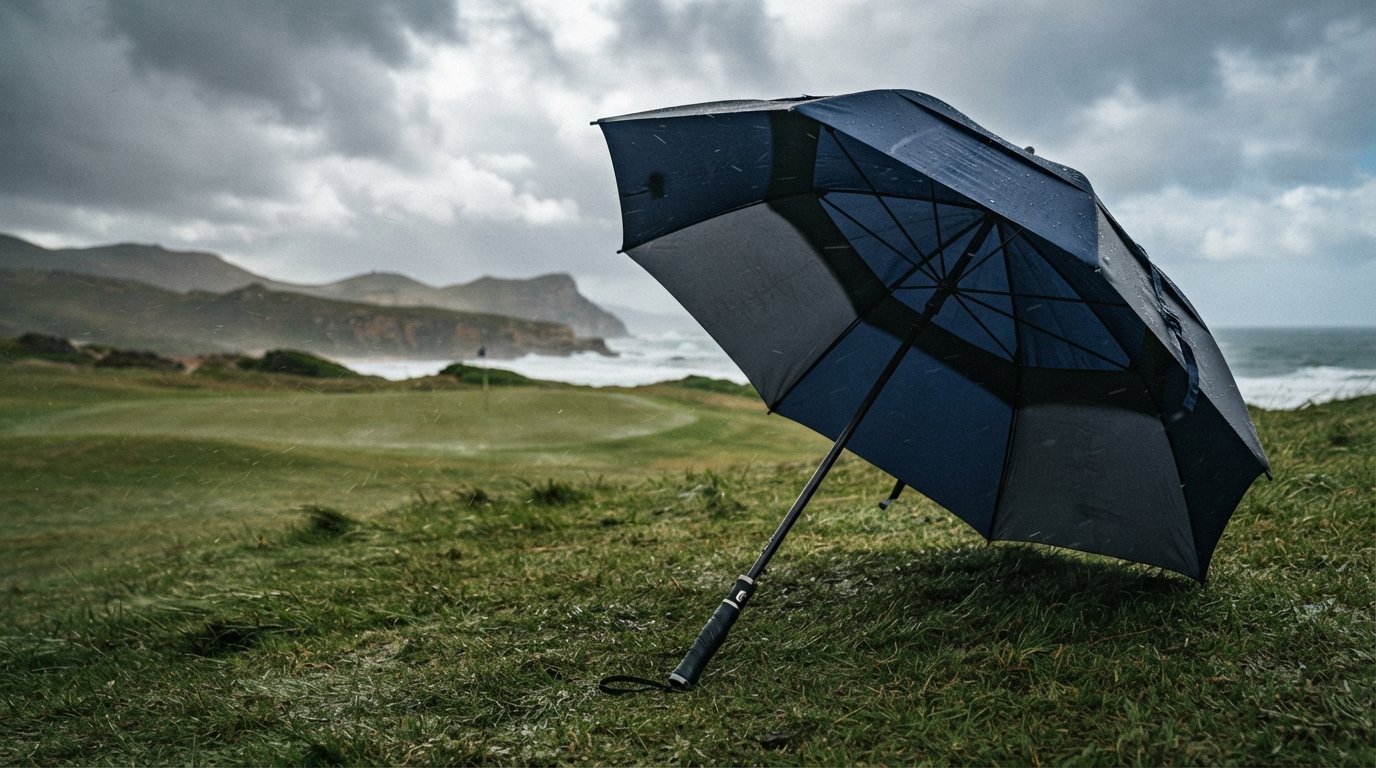
Single-canopy umbrellas fail primarily due to aerodynamic lift. In open terrain, sudden updrafts fill a solid fabric dome like a spinnaker sail, concentrating immense upward pressure against the rib tips until the assembly inverts. A dual-tier fibreglass golf umbrella neutralises this parachute effect through mechanical pressure release. By splitting the canopy into two distinct tiers, air forced beneath the lower tier escapes freely through designated perimeter vents, dramatically decreasing aerodynamic drag.
Preventing Umbrella Blowouts
The double-canopy architecture relies on a series of reinforced vent apertures spanned by heavy-duty elasticated tension straps. Under calm conditions, these straps hold the upper fabric tier flush against the lower panel, ensuring complete water repellency during vertical downpours. When aggressive updrafts strike, the elastic flexes outward, creating a temporary escape passage.
Independent field tests on vented windproof canopies and fibreglass ribs confirm that this dual-action design withstands sustained winds between 64 km/h and 88 km/h without structural inversion. The composite ribs work in direct synergy with the vents, bending momentarily under peak loads while the fabric channels air away from the underside.
Procurement teams must distinguish between authentic dual-tier construction and cosmetic imitations. Low-cost promotional models occasionally feature layered panels stitched directly over solid backing fabric without genuine exhaust apertures, offering zero pressure relief. A professional-grade assembly incorporates wide vent openings, reinforced perimeter hems, and industrial bar-tack stitching at every anchor point.
Stability and User Comfort
Beyond preventing mechanical failure, canopy venting significantly improves user handling. Without an exhaust path, turbulent gusts exert strong rotational torque and lift, forcing the user to struggle against the umbrella to maintain control on exposed fairways.
The air-vented system maintains canopy structural integrity amongst sudden gusts by equalising atmospheric pressure across both sides of the fabric. Combined with an eight-rib radial geometry, this continuous pressure balance distributes physical tension evenly across the entire frame. The result is a stable, quiet umbrella that remains planted in the user’s grip, even during abrupt squalls.
Sourcing Golf Umbrellas for Clubs and Corporate Use
Procurement choices reflect directly on an organisation’s institutional standards. When hosting an executive golf day or outfitting a private country club, distributing sub-standard gear undermines the hospitality experience. Specifying an authentic 32-inch fibreglass golf umbrella ensures your branded equipment remains functional throughout variable weather, transforming a practical necessity into an enduring brand asset.
Canopy scale offers practical advertising real estate. An open 64-inch arc features expansive panels that comfortably house tournament crests, corporate emblems, and sponsor identities without visual cramping. Maintaining high panel tension across every rib guarantees that corporate graphics stay crisp, legible, and undistorted from the driving range to the clubhouse terrace.
Wholesale Considerations for South African Businesses
Securing fleet orders demands a supply partner with robust logistics and verifiable manufacturing consistency. The Umbrella Man has operated as a national manufacturer and wholesale specialist across South Africa since 2009, maintaining national supply capability for bulk requirements. Partnering with an established domestic manufacturer ensures uniform colour matching across entire fleets, eliminating the dye-lot variations common with unvetted imports.
Managing inventory across multiple club seasons requires structured storage practices:
- Canopy drying: Ensure staff fully dry fabric assemblies prior to tight bundling, preventing mildew and preserving surface water-repellency.
- Vertical staging: Store cased units upright in designated, ventilated bins to avoid premature strain on internal elastic tension straps.
Ergonomics and Professional Finish
User experience depends heavily on lower-frame architecture. While moulded plastic handles become slippery when damp, high-density EVA foam grips offer secure, non-slip handling in pouring rain. EVA foam remains neutral to the touch in freezing winds and provides sufficient cushioning to prevent hand cramping during long walks between holes. Standardising on handle diameters between 35 mm and 40 mm also ensures seamless compatibility with commercial golf push carts.
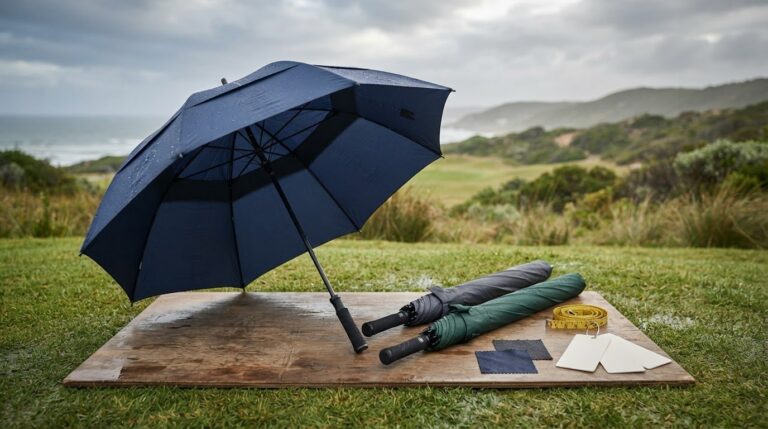
Corporate aesthetics must match the venue. While vibrant panels suit promotional giveaways, corporate estates generally favour understated tones like navy, bottle green, and classic black. A tailored fibreglass golf umbrella finished with matching ribs, runners, and ferrule hardware delivers a refined presence that honours tournament traditions. To source proven tournament inventory for your next fixture, contact The Umbrella Man for bulk corporate enquiries.
The Umbrella Man Standard: 32″ Air‑vented Fibreglass
Procuring sporting equipment requires total confidence in material execution. As a national manufacturer and wholesaler operating since 2009, The Umbrella Man has engineered its flagship commercial product specifically for intensive commercial and sporting use: the 32″ Air‑vented Fibreglass Golf Umbrella. This design balances mechanical strength against everyday practicality, creating a dependable weather barrier suited to demanding South African conditions.
Every element of the build reflects deliberate engineering. The structural spine comprises a reinforced 14 mm solid fibreglass shaft paired with 5 mm solid composite ribs, creating a torsionally stable skeleton that resists high-velocity winds. An automated release mechanism incorporates a smooth safety runner to prevent pinched fingers during swift deployment. Covering the frame is a tight weave of high-density 190T pongee fabric, offering immediate water runoff alongside robust ultraviolet protection.
A Dependable Partner for National Supply
Fleet procurement succeeds when backed by proven logistical infrastructure. The Umbrella Man maintains comprehensive national supply capability, handling volume consignments for corporate hospitality, automotive dealerships, and national tournaments alongside smaller operational top-ups. This domestic footprint ensures steady stock availability, short lead times, and predictable dispatch across South Africa.
A philosophy of quiet competence defines every tier of manufacturing. Rather than relying on superficial styling or fragile moving parts, each fibreglass golf umbrella prioritises functional endurance. From the corrosion-proof composite joinery to the ergonomic high-density EVA foam handle, every component is selected to perform consistently across multiple sporting seasons.
Final Checklist for Your Purchase
Before issuing procurement approval for your club or corporate fleet, verify that your specifications meet the following commercial benchmarks:
- Frame composition: Ensure both shaft and ribs consist of solid fibreglass rather than coated aluminium or electroplated steel, securing essential dielectric safety and complete rust immunity.
- Ventilation integrity: Confirm an authentic double-canopy system connected by elasticated tension straps, rather than cosmetic layered fabric that traps internal wind pressure.
- Ergonomic utility: Check for non-slip EVA foam grips scaled to fit standard push-cart brackets.
To inspect comprehensive specifications or discuss fleet requirements for your club or commercial event, view the professional range at The Umbrella Man.
Securing Long-Term Performance for Your Fleet
Selecting equipment for your venue or corporate event requires looking past surface aesthetics to core engineering. A true 32-inch radius delivers reliable coverage across the green, whilst non-conductive, rust-proof composite construction eliminates the warping and coastal oxidation typical of outdated steel frames. When paired with genuine pressure-relieving canopy vents, investing in a commercial fibreglass golf umbrella protects your players against sudden downpours and preserves your club’s presentation standard.
Since 2009, The Umbrella Man has operated as a specialist manufacturer and wholesaler, supplying robust outdoor products across South Africa. As a dependable national supplier for leading sporting clubs and corporate hospitality teams, we build gear designed to perform through intense squalls and harsh sunlight alike. Take the uncertainty out of your next procurement cycle. Explore our professional 32-inch fibreglass range at The Umbrella Man and equip your fleet with tournament-ready durability today.
Frequently Asked Questions
Is a fibreglass golf umbrella really safer in a thunderstorm?
Fibreglass is a dielectric insulator, so it does not conduct electrical current or act as a galvanic conductor like a steel shaft. While this material reduces electrical risk, it does not make playing during an active storm safe. Golfers caught on an open course must immediately lower any raised equipment, suspend play, and seek designated lightning shelters as outlined by official course safety guidelines.
What is the difference between a 30-inch and a 32-inch golf umbrella?
The difference lies in the rib radius and total protective canopy spread. A 30-inch model provides an arc of roughly 60 inches, which suits single players with minimal gear. A 32-inch fibreglass golf umbrella expands to an open arc of roughly 64 inches, generating a flat coverage diameter between 54 and 58 inches that comfortably shields two to three adults alongside touring equipment.
Can air-vented umbrellas still leak during heavy rain?
Authentic double-canopy systems do not leak under standard downpours. The construction features an upper fabric tier that broadly overlaps the lower tier’s perimeter vents. High-tension elastic retainers hold this top panel firmly against the inner fabric, creating a watertight seal during downward rain. The vents only flex outward when internal wind pressure forces an exhaust path from beneath the frame.
Why do fibreglass umbrellas cost more than steel ones?
Composite manufacturing requires specialised pultrusion techniques, high-tensile resins, and tailored tooling rather than basic pressed metal. Although the initial wholesale cost reflects this technical production, composite hardware provides a lower cost of ownership over time. Fibreglass resists permanent wind deformation, eliminates coastal salt corrosion, and prevents premature frame failure, making it a far more cost-effective long-term investment for commercial fleets.
How much wind can a professional air-vented golf umbrella withstand?
Independent wind-tunnel assessments show that professional double-canopy fibreglass umbrellas withstand continuous winds between 64 km/h and 88 km/h without inverting or suffering structural damage. The flexible composite ribs absorb dynamic gusts, whilst the dual-layer vents prevent aerodynamic pressure buildup underneath the canopy, ensuring the umbrella stays intact in challenging coastal or highveld squalls.
Are these umbrellas suitable for corporate branding and logos?
The 32-inch format is ideal for corporate and tournament branding. Large canopy panels provide ample, flat surface area for crisp screen printing and heat-transfer graphics without distortion. Premium 190T or 210T high-density pongee fabric holds pigment cleanly, ensuring corporate crests, tournament emblems, and sponsor identities remain vivid and legible across the fairways.
Do you provide national delivery for bulk wholesale orders in South Africa?
The Umbrella Man supplies commercial clients, sports clubs, and promotional agencies with national delivery capability across South Africa. Operating as a manufacturer and wholesaler since 2009, the business handles volume logistics for large-scale corporate events alongside smaller institutional top-up orders. Standard shipping rates apply based on order volume and destination logistics.
What handle type is best for professional golf use?
High-density, closed-cell EVA foam handles offer the best performance for professional golf applications. Unlike hard plastics or untreated rubber, textured EVA provides a firm, slip-resistant grip in torrential rain and insulates against cold morning winds. Sizing the handle diameter between 35 mm and 40 mm also ensures full compatibility with standard push-cart umbrella holders.