Cost of Quality vs Cheap Promotional Umbrellas: A 2026 Buyer’s Guide
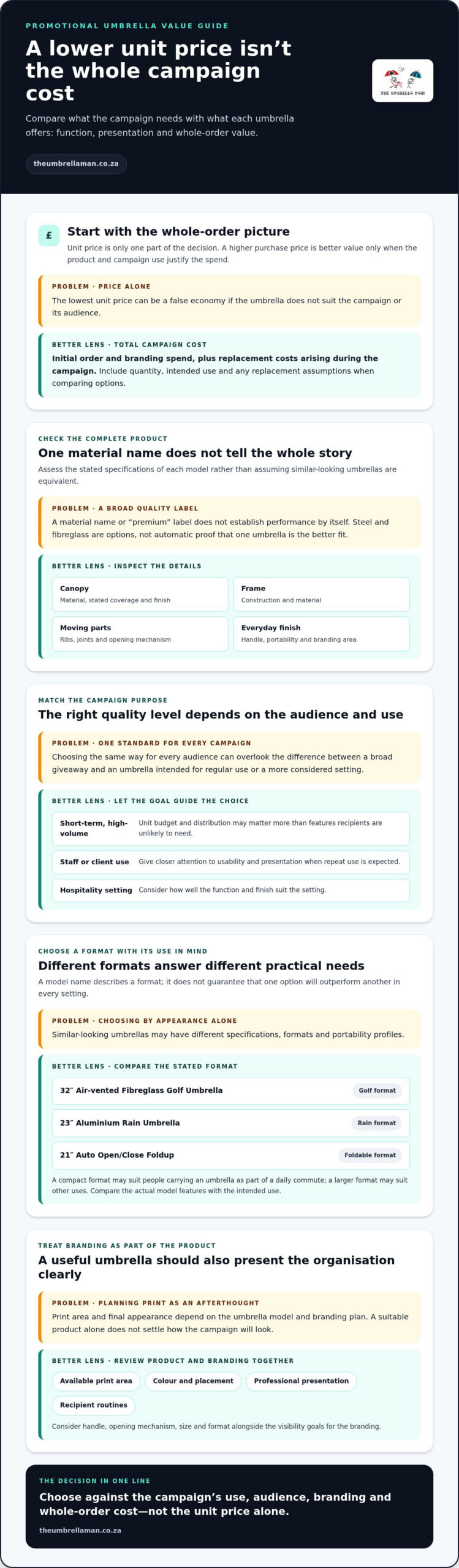
The lowest unit price can be a false economy if an umbrella doesn’t suit the campaign or its audience. That’s the central question behind the cost of quality vs cheap promotional umbrellas: will paying more deliver better value, or will a lower-cost option do the job? Price is easy to compare, but it doesn’t show whether an umbrella fits its intended use or presents your brand effectively.
It’s sensible to keep campaign budgets in view, particularly when ordering in volume. A higher purchase price represents better value only if the construction, format and expected use justify the full order cost. A poor fit may undermine the purpose of a giveaway, whilst a practical choice can support repeat use and consistent branding.
This guide compares options by whole-order value, not unit price alone. You’ll assess construction, branding and campaign needs, then match umbrella formats to your audience and distribution plans. The Umbrella Man manufactures and supplies umbrellas for commercial and promotional requirements, including golf, rain and foldable formats.
Key Takeaways
- Compare the cost of quality vs cheap promotional umbrellas by considering function, presentation and campaign needs, not purchase price alone.
- Assess the canopy, frame, ribs, joints and opening mechanism against how and where recipients are likely to use the umbrella.
- Use a whole-order calculation that accounts for quantity, branding, intended use and clearly stated replacement assumptions.
- Match the umbrella format and quality level to the campaign, whether it’s a broad giveaway, staff use, a client gift or a hospitality setting.
- Compare umbrella formats against your requirements when planning an order for a business, school or hospitality team.
Cost of quality vs cheap promotional umbrellas: what are you comparing?
The cost of quality vs cheap promotional umbrellas is not simply a choice between a high and low unit price. It’s a comparison of what the campaign gets for its spend: a suitable product, useful function, professional presentation and a format recipients can use as intended. An umbrella carried in public or used at work also displays the organisation’s branding.
Purchase price is the initial outlay. Total campaign cost also includes any later replacement needed to maintain the campaign’s intended reach. In short, total campaign cost is the initial order and branding spend, plus replacement costs arising during the campaign. This connects with the broader Cost of Quality, which considers both the effort involved in meeting quality requirements and the costs associated with failures.
The right balance depends on the purpose. A high-volume giveaway with brief engagement may place greater weight on unit budget and distribution. Umbrellas intended for staff, regular client use or hospitality settings may warrant closer attention to usability and presentation. Neither purpose makes one quality level universally right. Let the campaign’s priorities guide the choice.
What makes a promotional umbrella cheap or quality-led?
Price alone doesn’t explain what an umbrella is made from or how it is put together. Compare the canopy material and finish, frame construction, ribs and joints, opening mechanism, and handle. These details can affect how the umbrella functions and feels to use, but a material name or “premium” label doesn’t establish performance by itself. Compare the stated specifications of each model rather than assuming similar-looking umbrellas are equivalent.
Format matters, too. A 32″ Air-vented Fibreglass Golf Umbrella, a 23″ Aluminium Rain Umbrella and a 21″ Auto Open/Close Foldup serve different practical needs. Their names indicate distinct formats, not a guarantee that one will outperform another in every setting. Start with how recipients are expected to use the item, then compare the model’s stated features with that need.
When does paying more make business sense?
A higher purchase price may be easier to justify when an umbrella is intended for repeat use, staff distribution, client gifts or a hospitality environment where presentation matters. In these cases, function and finish can be as relevant as the number of units ordered. Paying more doesn’t automatically guarantee a longer usable life or a better return. Value depends on the specific product, how it will be used and the campaign’s objectives.
For short-term, high-volume distribution, wider reach may matter more than features recipients are unlikely to need. Set the campaign goal first, then compare options against it. This is more practical than choosing by price alone.
Which umbrella quality factors have the greatest effect on value?
Assess an umbrella as a complete product, not by one material label or a broad “quality” claim. The canopy, frame, ribs, joints and opening mechanism work together to affect how it functions. Handle design, portability and finish also shape whether recipients find it convenient to use and whether it presents your organisation appropriately.
Before ordering, compare the canopy material and coverage, frame and rib construction, joints, opening mechanism, handle, finish and branding area against the intended use. This checklist makes the cost of quality vs cheap promotional umbrellas easier to judge because it focuses on model-specific features rather than price or assumptions about a single material.
How do canopy and frame specifications affect use?
Start with the campaign setting. Consider the canopy material, stated coverage and finish in relation to where recipients are likely to use the umbrella and how they’ll carry it. A compact format may suit people who need to carry an umbrella as part of a daily commute, whilst a larger format may suit other uses. Treat these as practical considerations, not guarantees of performance.
Steel and fibreglass are frame-material options, but neither is universally superior without comparing the actual construction and intended use. Check how the ribs and joints are described, and include the opening mechanism in your review of the full specification. The 32″ Air-vented Fibreglass Golf Umbrella is one defined format; its name alone doesn’t establish how it compares with another model for a particular campaign.
How should buyers assess branding and everyday usability?
Branding is part of the product’s visible finish. Consider whether the available print area, colour and placement suit the campaign’s visibility goals and create a clear, professional presentation. The print area and final appearance depend on the umbrella model and branding plan, so assess them alongside the product. A commercial umbrella range gives businesses formats to compare against their promotional requirements.
Usability matters, too. Consider whether the handle suits the expected user, whether the opening mechanism is convenient, and whether the umbrella’s size and format fit recipients’ routines. A folding option, for example, has a different portability profile from a golf umbrella. When planning the visual side of a campaign, decide how the branding should appear before comparing suitable formats.
The American Society for Quality’s Cost of Quality (COQ) methodology offers a useful way to think about quality-related decisions: assess the effort invested in meeting requirements alongside the consequences of items that don’t meet the intended need. Applied to umbrellas, that means weighing specifications and presentation against campaign purpose, without assuming that a higher price guarantees a better result.
How to compare the total cost of quality and cheap promotional umbrellas
A fair comparison puts complete campaign quotes alongside the assumptions that shape their value. A low unit cost can suit a short campaign where broad distribution is the priority. It isn’t automatically the lowest total cost if replacements are needed or the umbrellas don’t meet the campaign’s functional requirements. Compare options using the same order quantity, branding brief and intended use to assess the cost of quality vs cheap promotional umbrellas fairly.
What belongs in a promotional umbrella cost comparison?
Record quoted items separately from assumptions. Include the product specification, unit price in R, order quantity, branding, packaging and delivery terms. Add how the umbrellas will be used, the expected frequency of use and any replacement provision. This makes differences visible instead of hiding them in a single total.
| Comparison factor | What to record |
|---|---|
| Product and unit price | Model, stated specification and quoted price per umbrella |
| Order and branding | Quantity, print requirements and any related quoted charges |
| Packaging and delivery | Items included in the quote and applicable delivery terms |
| Use and frequency | Campaign purpose and whether use is occasional or expected to recur |
| Replacement assumptions | Any planned allowance, clearly labelled as an assumption rather than a lifespan claim |
Use the same basis for each option. If a quote excludes branding or delivery, show those as separate amounts in R rather than treating the unit price as the complete campaign cost. Keep confirmed quote items distinct from estimates, and don’t assume packaging or replacement costs are included unless the quote says so.
How can buyers assess value without invented lifespan figures?
Compare samples or documented specifications with the campaign’s practical requirements. For a short distribution drive, planned recipient reach may be the relevant denominator. For a campaign expecting repeat use, calculate against a conservative estimate of usable items and label it as a scenario, not a prediction.
Cost per usable item = total campaign spend ÷ estimated usable items. Alternatively, cost per planned recipient reached = total campaign spend ÷ planned recipient reach. Total spend should include quoted product, branding, packaging and delivery costs, plus any explicitly stated replacement allowance. These measures answer different questions: recipient reach is not the same as repeat brand exposure.
Run a cautious scenario alongside your main estimate, using assumptions your team can explain. Don’t assign an unsupported lifespan or promise a return. When planning visibility and distribution, decide which outcome matters most and use the matching calculation.
How to choose the right quality level for your umbrella campaign
Choose specifications around the campaign, not an assumed quality tier. A mass giveaway, staff issue and client gift have different priorities. Work through these steps to define what matters before comparing options:
- Define the use. Identify whether the umbrella is for a one-off giveaway, regular staff use, a client-facing gift or a hospitality setting. Consider where recipients are likely to use it and how often.
- Identify the audience. Think about recipient needs, such as portability for people on the move or a format suited to outdoor activities.
- Set the quantity. Estimate distribution numbers and account for the campaign’s reach. Order quantity affects procurement planning, so compare quotes for the same quantity wherever possible.
- Select the product type. Match the format to the use. For golf or outdoor activities, compare a relevant option such as the 32″ Air-vented Fibreglass Golf Umbrella with formats suited to other campaign needs.
- Specify the requirements. Record the product’s stated features and the functional needs it must meet. Avoid relying on broad claims about quality or durability.
- Plan the branding and order details. Finalise artwork and branding requirements, and set the required delivery schedule. Document assumptions alongside specifications in your procurement comparison.
Consistency matters, particularly for larger orders or campaigns distributed across teams or locations. Keeping product specifications and branding consistent helps procurement teams compare like with like, plan allocation and avoid assessing options against different requirements. If quantities or needs vary by audience, record those differences rather than combining them in one broad estimate.
Which quality level suits different campaign goals?
For broad distribution, balance functional requirements against the available campaign budget and intended reach. A short-term giveaway may call for a different balance from umbrellas intended for regular staff use. For client gifts or hospitality settings, suitable construction and considered presentation may carry more weight. No single tier suits every campaign, and a higher price alone doesn’t establish that a product is the better fit.
Once you’ve set your selection criteria, explore promotional umbrella options for your campaign and compare formats against your requirements. Consider how the branding, product format and distribution plan work together.
Why work with an established South African promotional umbrella supplier?
A supplier familiar with commercial umbrella requirements can help buyers compare product formats against campaign objectives and order scale. The Umbrella Man manufactures and supplies umbrellas to businesses and other commercial customers across South Africa. The company’s experience in the South African market provides context for organisations planning promotional orders.
What does an established supplier bring to procurement?
Different buyers have different priorities. A retailer planning a promotion may focus on distribution and brand presentation, whilst a school, promotional company or hospitality business may need a format suited to its audience and setting. A range of umbrella types gives procurement teams options to consider, without assuming one style or quality level fits every use.
Clear product specifications make those choices more confident. Buyers can compare stated features, intended use and branding requirements, then document them alongside order quantity and budget. This keeps the decision grounded in the campaign rather than broad claims about quality. For larger orders, consistent specifications also help teams plan quantities and align products across the order.
How can The Umbrella Man support a value-led choice?
Different formats serve different practical purposes. A 32″ Air-vented Fibreglass Golf Umbrella may suit golf-related or outdoor requirements, whilst a 23″ Aluminium Rain Umbrella or 21″ Auto Open/Close Foldup offers another format to assess against the intended audience and use. These examples are starting points for comparison, not a claim that any one option is right for every campaign.
The cost of quality vs cheap promotional umbrellas depends on how well the product and order meet the campaign brief. Consider target recipients, planned distribution, branding and likely use alongside the available budget. The Umbrella Man accommodates large-volume wholesale requirements for businesses organising broader promotional orders. A clear brief connects quantity and product choice to campaign goals without relying on unsupported lifespan or return assumptions.
For a value-led procurement decision, define the use, record the required specifications and assess suitable formats against the order’s scale. Explore The Umbrella Man’s umbrella range and discuss a suitable commercial order for your campaign.
Make your next umbrella campaign a considered choice
The cost of quality vs cheap promotional umbrellas comes down to fit, not price alone. Compare each option’s specifications and branding with the campaign’s audience and intended use. Then assess the whole order, including quantity and clearly stated replacement assumptions, so your decision reflects the value you expect rather than an unsupported lifespan claim.
Whether you’re planning broad distribution or choosing umbrellas for regular business use, a clear brief helps balance campaign reach, presentation and budget. The Umbrella Man manufactures and supplies umbrellas for commercial and promotional requirements, with large-volume wholesale ordering for businesses.
Explore The Umbrella Man’s umbrella range to compare formats for your campaign and plan a commercial order around your requirements.
Frequently Asked Questions
Is a quality promotional umbrella worth the extra cost?
It may be worth the extra cost when recipients are expected to use the umbrella repeatedly or when presentation matters to the campaign. It isn’t automatically the best choice for every giveaway. Compare the specification, quantity, branding, intended use and replacement assumptions against your campaign objective. Judge the cost of quality vs cheap promotional umbrellas by their fit for purpose, not by price alone.
What makes a promotional umbrella high quality?
Quality depends on how an umbrella’s features suit its intended use, rather than on a single label. Compare the canopy material and finish, frame and rib construction, joints, opening mechanism and handle. Consider the branding’s appearance and placement, too. A higher price or a general claim that an umbrella is “premium” doesn’t prove it will perform better. Review the stated specifications against your campaign’s practical needs.
How can a business compare the cost of cheap and quality promotional umbrellas?
Compare equivalent options using the same product format, order quantity, branding requirements and delivery terms. Include packaging and any planned replacement allowance in the total campaign spend, keeping quoted amounts separate from assumptions. Then divide total spend by the estimated usable items or planned recipient reach. These measures answer different questions, so choose the one that matches your campaign goal. Clearly label estimates, and don’t present an unverified lifespan as fact.
Can cheap promotional umbrellas still be a good choice?
Yes. A lower-cost option may suit a campaign where broad distribution and a tight unit budget are priorities, provided it meets basic functional and presentation requirements. Consider who will receive the umbrellas and how they’re expected to use them. If repeat use matters, compare construction and usability as well as the initial price. A lower unit cost can be appropriate, but it doesn’t automatically mean a lower total campaign cost.
What happens if a promotional umbrella does not last?
The effect depends on the campaign. Replacing items can add procurement work and affect the giveaway’s usefulness, whilst a short-term distribution campaign may have different priorities. Avoid assuming a particular product lifespan or replacement rate without supporting evidence. Instead, compare documented specifications with intended use, then include any replacement allowance as a clearly stated scenario in your cost assessment, not as a prediction or guarantee.
Which promotional umbrella is best for a business campaign?
The best format depends on the audience, setting, distribution plan and branding goals. A golf umbrella, compact folding umbrella or standard rain umbrella may suit different requirements. For example, compare the 32″ Air-vented Fibreglass Golf Umbrella with the 21″ Auto Open/Close Foldup or 23″ Aluminium Rain Umbrella based on their stated specifications and intended use. No single format is right for every business.
Does a higher-quality promotional umbrella always create better brand exposure?
No. Exposure depends on whether recipients find the umbrella useful, use or carry it, and can see the branding clearly. A suitable product may support repeat use, but quality alone can’t guarantee attention or campaign results. Set a clear objective, then assess the umbrella’s format, construction, branding, quantity and likely context of use together. This gives you a more grounded basis for judging its potential contribution to the campaign.