How to Anchor a Garden Parasol: Securing Cantilevers
What if the heaviest-looking base still isn’t the safest choice for your patio? When you’re working out how to anchor a patio umbrella, the answer depends on more than canopy size. A cantilever’s offset pole creates leverage, so wind can pull unevenly against its base. The patio surface matters too, especially where paving, concrete or a timber deck limits fixing options.
It’s sensible to be cautious about a large canopy tipping or shifting. Simply adding weight won’t remove every risk. A stable setup starts with matching the anchoring method to the umbrella’s instructions and the surface, then assembling and positioning the base correctly.
This guide explains how to choose between a weighted base, a bolt-down mount and an in-ground anchor, and what to consider when fixing options are limited. You’ll also learn how to reduce avoidable movement and recognise when wind or other conditions make closing the canopy the safer choice.
Key Takeaways
- Learn how to anchor a patio umbrella by matching its base or fixing method to the umbrella design and patio surface.
- Understand why a cantilever’s offset canopy places extra leverage on its base, making a compatible, stable setup essential.
- Use the manufacturer’s instructions to guide base selection and assembly, rather than relying on a general weight rule.
- Set the umbrella on a firm, level surface and check that its fittings are secure before opening the canopy cautiously.
- Recognise that ballast cannot make every condition safe; follow operating guidance and close the canopy when required.
How to anchor a patio umbrella and why cantilever designs need care
Anchoring means stabilising the umbrella and its base with a setup suited to the umbrella’s design and the patio surface. It isn’t simply a matter of placing something heavy beside the pole. The base, any fixing or ballast, the surface beneath it and the way the umbrella is assembled all affect how steadily it stands.
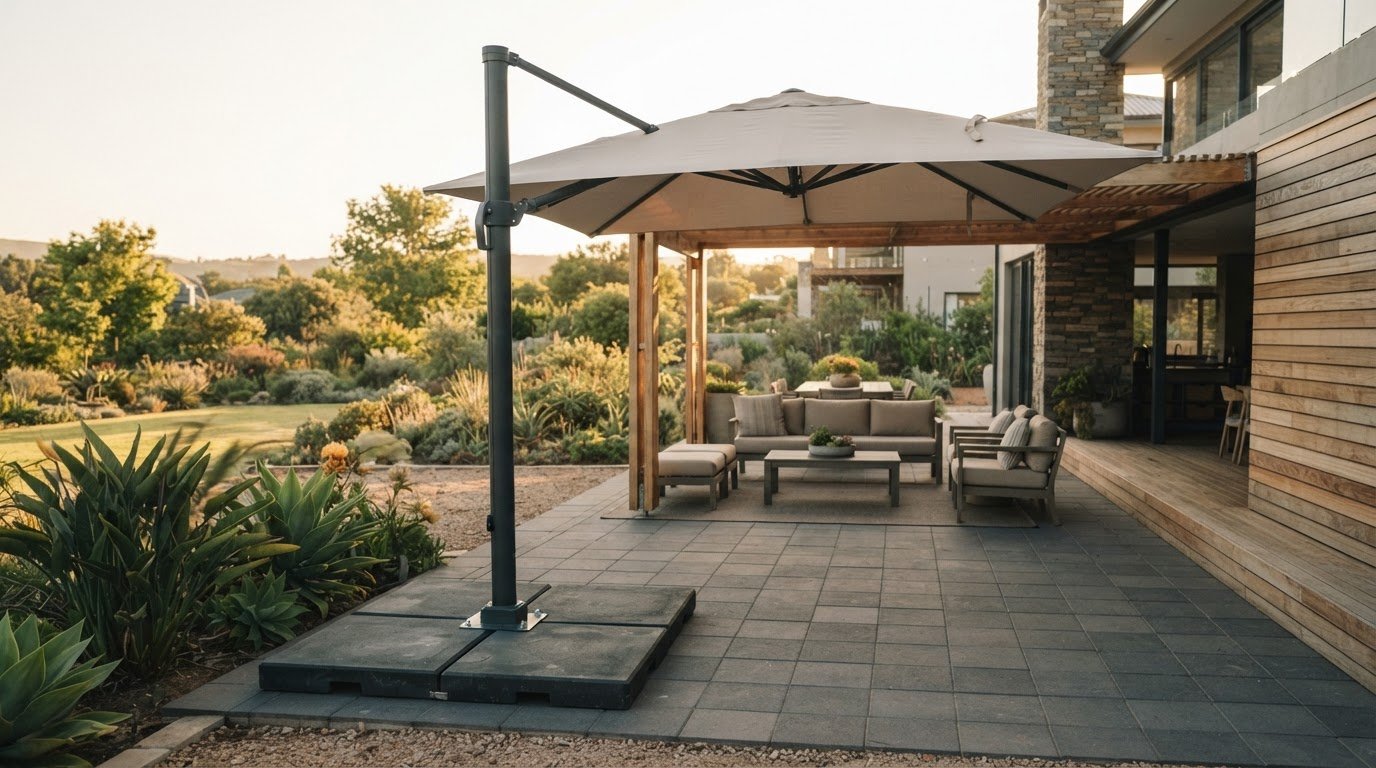
A cantilever umbrella has its canopy supported from the side, rather than centred directly above a straight pole. This changes how forces act on the base. The canopy’s weight and wind pressure are offset from the support, creating leverage that can pull or tilt the base. This doesn’t mean every cantilever umbrella is unstable; it means the support needs to suit the specific design. General descriptions of parasols and umbrellas can be found in the Umbrella overview, but anchoring decisions should follow the relevant maker’s instructions.
What makes a cantilever umbrella different to anchor?
On a straight-pole parasol, the canopy sits above the pole and its support is usually centred beneath it. A cantilever canopy extends away from its supporting pole, so the base must resist forces acting off-centre. Canopy size, pole construction and the umbrella’s tilt or rotation settings can all affect stability. Don’t assume that one base arrangement will suit every cantilever model.
Before choosing an anchoring method, identify the umbrella model and read its guidance. The umbrella and base makers’ instructions take priority over generic advice, including rules of thumb about ballast or installation.
What does a stable patio umbrella setup involve?
Think of the setup as a connected system: the umbrella must fit its base, the base or anchor must suit the surface, and every component must be assembled and secured as directed. A fixing designed for one type of surface may not hold securely on another. Similarly, a base that looks substantial may still be incompatible with the umbrella’s pole or support frame.
Start with a firm, flat position where the base can sit evenly and the umbrella can open without striking nearby objects. An uneven or unsuitable surface can let the base rock or shift, or put extra strain on the fittings. Check the surface and assembly before opening the canopy rather than relying on its weight to settle the setup.
A stable patio umbrella setup is one in which the umbrella, compatible support and suitable surface work together as instructed. That principle is central to how to anchor a patio umbrella safely: assess the complete arrangement, not just the base in isolation.
Choose a cantilever umbrella anchor to suit the base and patio surface
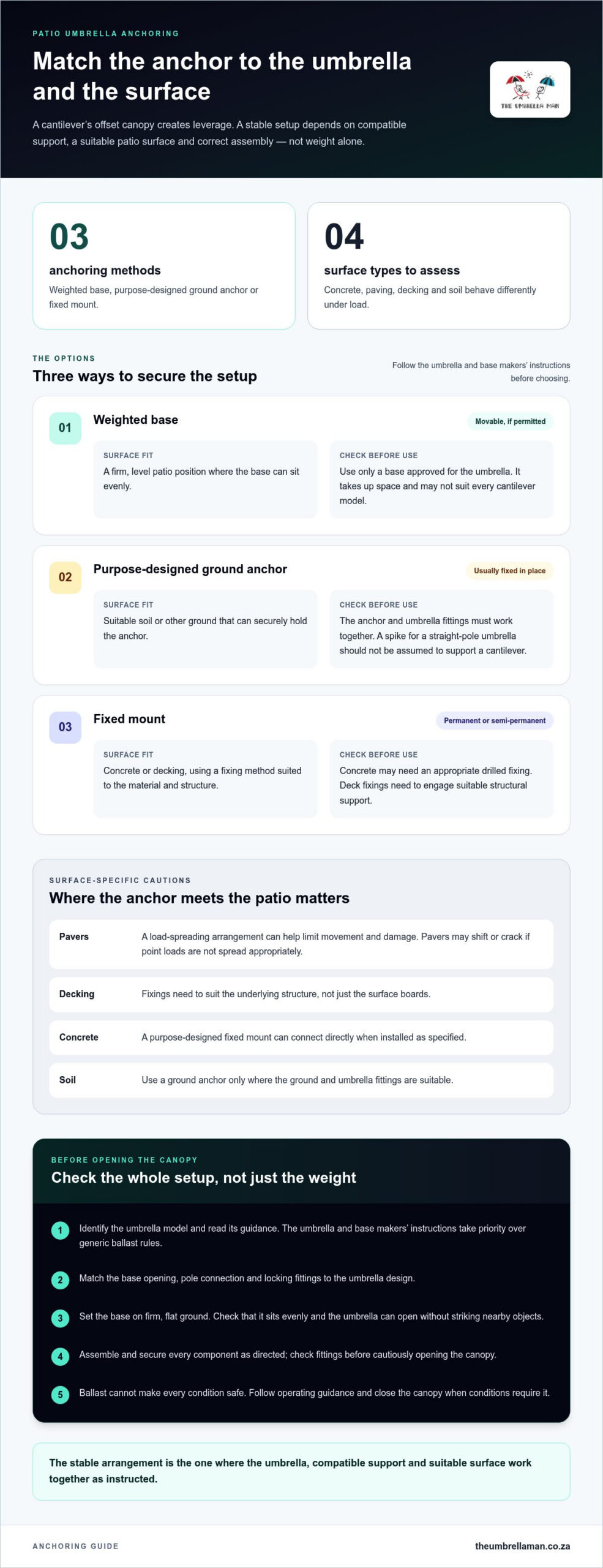
The right anchoring method depends on the cantilever model, its permitted base arrangement and the surface beneath it. A movable weighted base may be practical if the umbrella maker allows it and the base is designed for that model. Fixed mounting may suit a more permanent position, while a ground anchor needs suitable soil and fittings that connect securely to the umbrella.
Concrete, paving, decking and soil behave differently under load, so don’t assume an option that works on one surface will suit another. A suitable match helps limit shifting and avoid unnecessary strain on the umbrella or patio. Check the instructions for both the umbrella and its base before deciding how to secure the setup.
| Method | Surface | Permanence | Compatibility and limitations |
|---|---|---|---|
| Weighted base | Typically suited to a firm, level patio position where the base can sit evenly. | Movable, subject to the model’s instructions. | Use only a base approved for the umbrella. It can take up space and may not be suitable for every cantilever design. |
| Purpose-designed ground anchor | Suitable soil or other ground that can securely hold the anchor. | Usually fixed in place. | The anchor and umbrella fittings must be designed to work together. A ground spike intended for a compatible straight-pole umbrella should not be assumed to support a cantilever. |
| Fixed mount | Concrete or decking, with a fixing method suited to the material and structure. | Permanent or semi-permanent. | Concrete may require an appropriate drilled fixing; deck fixings need to engage suitable structural support. Pavers may shift or crack if point loads are not spread appropriately. |
Which anchoring options work on different patio surfaces?
On concrete, a purpose-designed fixed mount can provide a direct connection when installed as specified. For decking, the fixing needs to suit the deck’s underlying structure, not just its surface boards. Pavers need particular care: a load-spreading arrangement can help limit movement and damage, while a loose or uneven base may shift. In soil, use a ground anchor only where the ground and umbrella fittings are suitable. A Plastic Umbrella Spike is intended for compatible ground-set umbrella setups, not automatically for cantilever models.
How should you check base and umbrella compatibility?
Match the base opening, pole connection and any locking fittings to the umbrella’s design. Follow the maker’s installation directions, including any model-specific ballast or fixing requirements. Avoid generic weight rules: cantilever models vary, and the umbrella and base instructions should determine the suitable arrangement. For practical guidance on umbrella options, explore outdoor umbrellas from The Umbrella Man.
How to weigh down a large cantilever umbrella safely
Follow the umbrella and base instructions in sequence. The correct ballast and fitting method vary by model, so don’t rely on a generic weight recommendation or add more weight than the base is designed to hold. A careful setup can reduce avoidable movement, but it can’t make an open canopy safe in conditions that exceed the maker’s guidance.
What is the safe setup sequence?
- Read the instructions first. Check how the umbrella must be assembled, which base types are permitted and what ballast, if any, the base requires.
- Inspect the components. Look over the base, pole, fittings and opening mechanism for visible damage, missing parts or looseness. Don’t assemble a setup with damaged or incomplete components.
- Position the base. Place it on the intended firm, level surface before mounting the umbrella. Secure or install the base as directed, then check that it sits evenly without rocking.
- Add the specified ballast. Use only the material and amount stated for that base, and fit or distribute it as the instructions show. Don’t substitute other weights or improvise a fixing.
- Mount and secure the umbrella. Fit the pole into the base as instructed, then engage the locks or other supplied fittings. Check that each connection is seated correctly.
- Test before fully opening. Operate the mechanism as directed, keeping the canopy closed during setup or adjustment if the instructions require it. Open cautiously and stop if the base shifts, the umbrella rocks or the mechanism catches.
How can you check that the umbrella is secure?
Before opening, check that the base makes even contact with the ground and that no part moves when you gently check the pole. Look for loose fittings, a tilted base or shifted ballast. Don’t force a lock or try to correct a rocking base by wedging objects beneath it. Reposition or reassemble the setup according to the instructions.
Keep the canopy closed during assembly and adjustment where the maker directs. Once open, continue to follow the umbrella’s operating guidance. If conditions exceed the maker’s stated limits, close the canopy. If it can’t be operated safely, leave it closed.
Position and secure the compatible base first, mount and check the umbrella next, then open the canopy cautiously as instructed. This is the practical order to follow when considering how to anchor a patio umbrella, without treating a successful setup check as a guarantee against movement in wind.
Prevent tipping: wind, positioning and everyday checks for patio umbrellas
A correctly weighted and anchored base helps support a cantilever umbrella, but it doesn’t make the canopy safe to leave open in every condition. Wind can change quickly, and gusts may put sudden strain on the canopy, pole, fittings and base. Follow the umbrella maker’s wind and operating instructions, and close and secure the canopy when conditions worsen or the instructions call for it.
When should you close a cantilever umbrella?
Close the canopy as wind increases, following the limits and operating guidance for your specific model. Don’t wait for the umbrella to sway noticeably before acting. Sudden gusts can arrive between visual checks, and an open canopy can catch the wind even when the patio initially seems calm. If you’re leaving the area for an extended period, close and secure the umbrella rather than leaving it open unattended.
Ballast is not a substitute for safe operation. It can’t remove the need to respond to changing weather, and a base that feels stable in calm conditions doesn’t guarantee the umbrella will remain stable in stronger or gusty wind. If you’re unsure whether conditions remain within the maker’s guidance, keep the canopy closed.
What should you inspect after setup and during use?
Make routine checks part of using the umbrella, particularly after moving it or changing its angle. Look for a change in the base position, shifted ballast, loose fasteners and locking points that no longer engage correctly. Check the patio surface too: settling, movement or damage beneath the base can affect how evenly it sits. If you find looseness, visible damage or rocking, close the canopy and address the setup according to the maker’s instructions before using it again.
- Check that the base remains in its intended position and sits evenly.
- Look for loose fittings, worn locking points or visible damage to the umbrella and support.
- Recheck stability after moving or adjusting the canopy.
- Close and secure the canopy whenever conditions worsen or the instructions require it.
For a related overview of wind considerations for beach umbrellas, read this wind-resistant beach umbrella guide. The same principle applies to how to anchor a patio umbrella: a sound setup needs ongoing attention, not just a careful installation.
For more outdoor umbrella options, explore umbrellas from The Umbrella Man.
A practical anchoring checklist for your patio umbrella
Before opening a patio umbrella, check the complete setup. Knowing how to anchor a patio umbrella means considering the model’s instructions, its support and the surface together, rather than relying on weight alone. If any part seems loose, uneven or incompatible, keep the canopy closed until the setup is corrected.
Use this quick checklist before opening the canopy
- Read the instructions: confirm the approved base or fixing method, and follow any model-specific requirements for ballast and assembly.
- Check compatibility: make sure the base opening and fittings suit the umbrella’s pole and design. Don’t assume a base intended for a straight-pole parasol will support a cantilever model.
- Assess the surface: position the base on a suitable, level area. Check that it sits evenly and that any surface-specific fixing is engaged as directed.
- Inspect the connections: check that fasteners, locking points and other fittings are secure, with no visible damage or signs of shifting.
- Test the mechanism carefully: operate the canopy as instructed, keeping it closed during setup or adjustment if the maker requires this. Open it cautiously and stop if the base moves or the mechanism does not work as directed.
- Consider the conditions: follow the maker’s operating and wind guidance. Close and secure the canopy when conditions worsen or the instructions call for it, and don’t leave it open unattended for an extended period.
These checks are a useful final review, not a guarantee that an umbrella can remain open in changing weather. Recheck the setup after moving or adjusting the umbrella, and close it if you notice rocking, shifting ballast or loose fittings.
Where does an umbrella spike fit into the decision?
An umbrella spike is a ground-set accessory for compatible umbrella arrangements. It isn’t a universal base, and you shouldn’t assume it can anchor a cantilever umbrella unless that model’s instructions specifically support the combination. The Plastic Umbrella Spike is relevant only to compatible ground-set applications.
If a different type of outdoor shade would suit your space better, consider the type of coverage and support your space requires before choosing. For umbrella and outdoor product options, explore The Umbrella Man’s range and use the product instructions to guide your setup.
Secure your umbrella setup with confidence
Choosing how to anchor a patio umbrella starts with the umbrella maker’s instructions. Match the base or fixing method to the model and patio surface, assemble each fitting as directed, and check that the support sits securely before opening the canopy. A cantilever’s offset design makes this careful matching especially important.
Ballast doesn’t make an umbrella safe in every condition. Follow the maker’s wind guidance, check for shifting or loose fittings, and close and secure the canopy when conditions worsen or the instructions call for it.
The Umbrella Man has supplied and manufactured umbrellas in South Africa since 2009. Its Plastic Umbrella Spike is for compatible ground-set applications, not a universal cantilever anchor. Explore The Umbrella Man’s umbrella and outdoor products to find options for your outdoor space. With a suitable setup and sensible checks, you can enjoy your patio while making safety part of everyday umbrella use.
Frequently Asked Questions
How heavy should a base be for a large cantilever umbrella?
There’s no safe universal base weight for every cantilever umbrella. The required base or ballast depends on the umbrella’s design, canopy and manufacturer’s instructions. Check that the base is specified for your model, then use only the permitted filling or weights. If the instructions don’t give clear guidance, don’t guess or assume that a heavier base makes every setup safe. Follow the maker’s directions for how to anchor a patio umbrella.
Can I use paving slabs to weigh down a cantilever umbrella?
Paving slabs may be suitable only if the umbrella or base instructions allow them and they fit securely in the intended arrangement. Loose or uneven slabs can shift, damage the base or create a trip hazard. Check that the surface is level, the base is compatible and all parts are properly restrained. Don’t improvise a stack of slabs as a substitute for the ballast specified by the maker.
Is a ground anchor better than a weighted base for a patio umbrella?
Neither option is automatically better; suitability depends on the umbrella, surface and installation. A compatible weighted base may suit a setup that needs to be movable, while a ground anchor requires suitable ground and fittings designed for that use. Check the approved options for your specific model and follow its instructions. Don’t attach a cantilever umbrella to an anchor that wasn’t designed to support it.
Can a cantilever umbrella stay open in windy weather?
Don’t assume a heavy base makes a cantilever umbrella safe to leave open in wind. Follow the manufacturer’s operating limits and close the canopy when conditions approach or exceed them. Close it when unattended if the instructions recommend this. Gusts can change quickly, so a setup that looks stable at one moment isn’t a guarantee of safe use as the weather shifts.
How do I stop a patio umbrella base from moving?
Place the base on a level surface and check that it’s compatible with the umbrella. Secure the umbrella and any ballast exactly as the instructions specify, then check for rocking, loose fittings or movement before opening the canopy. Avoid improvised weights that could slide or fall. If the base continues to shift, close the umbrella and reassess the surface and the approved anchoring method.
Can I use an umbrella spike for a cantilever umbrella?
Use an umbrella spike only with an umbrella it’s designed to support. A cantilever canopy sits away from its pole, so a spike shouldn’t be treated as a substitute for a compatible cantilever base. Check the instructions for both items before use, and don’t assume an accessory intended for a beach umbrella will fit a patio model. Compatibility needs to be established for the specific setup.
Should I close a cantilever umbrella when it is unattended?
Closing an unattended cantilever umbrella is a sensible precaution, particularly if the weather may change. Follow the model’s instructions for closing and securing the canopy and adjusting the frame. Before leaving it, check that it’s closed and locked as directed. A weighted base doesn’t remove the need to manage the canopy or respond to changing conditions, so keep it closed whenever the maker’s guidance calls for this.