Cantilever vs Centre-Pole Umbrellas for Poolside Shade and Clearance
For most poolside layouts, a cantilever umbrella is the more practical choice. In the cantilever umbrella vs centre-pole decision for pools, its side-mounted mast leaves the space beneath the canopy and beside the water clear, whilst a centre-pole umbrella suits a smaller area where fixed shade is sufficient. Wind exposure and the space needed for the base still matter.
A centre pole can interrupt a furniture layout or walkway, but it works well when the seating area is compact and the shade does not need to move. A cantilever can be adjusted to follow the sun, though its arm and base need room, and it must be secured according to the manufacturer’s instructions.
This guide compares both types for wind exposure, base footprint, walkway clearance and everyday poolside use. It explains when each design makes sense, what to measure before choosing a position, and why centre-pole umbrellas remain useful for simple seating zones. You’ll be better placed to choose shade that fits the layout, rather than judging by canopy coverage alone.
Key Takeaways
- Map the sun’s position against the seating area to judge whether fixed shade or an adjustable canopy better fits your poolside layout.
- Include the cantilever umbrella’s base, support arm and open canopy when measuring space, not just the shaded area.
- Factor wind exposure into the decision: use the fixing specified for the umbrella and follow its operating instructions.
- Keep centre-pole umbrellas in consideration for compact seating zones, including café-style layouts where a central pole suits the arrangement.
- Compare the 2.0m 160gm Poly-Canvas Beach Umbrella and other beach umbrella options when considering portable shade for outdoor use.
Cantilever or Centre-Pole: Which Umbrella Works Best Poolside?
A cantilever suits poolside layouts that need clear space beneath the canopy. A centre-pole design can suit compact seating where its fixed shade and central support fit the arrangement.
Cantilever umbrella layouts and shade adjustment
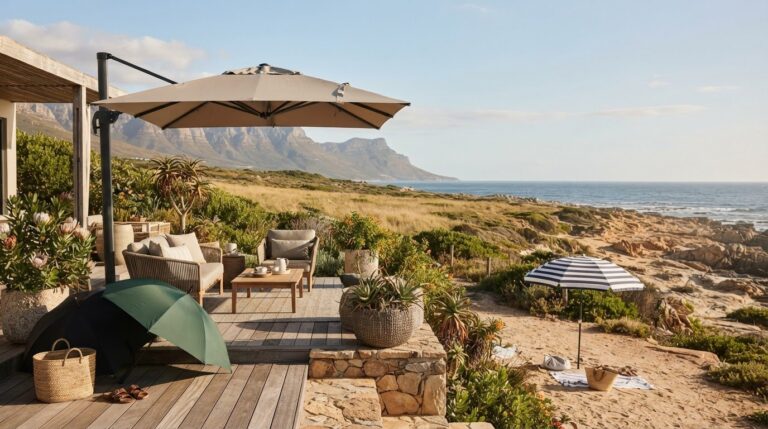
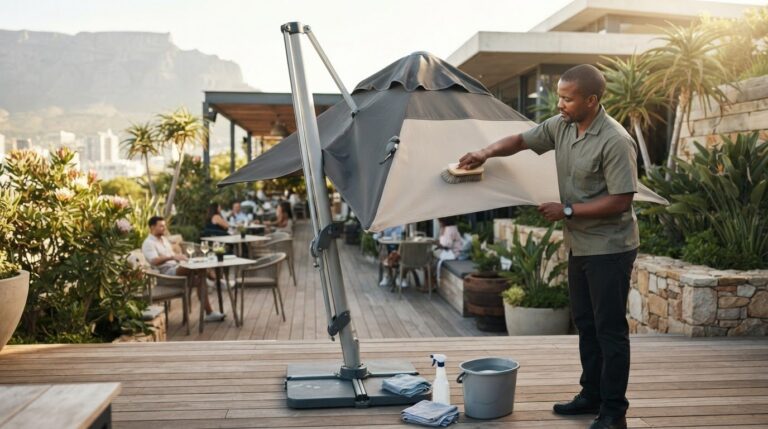
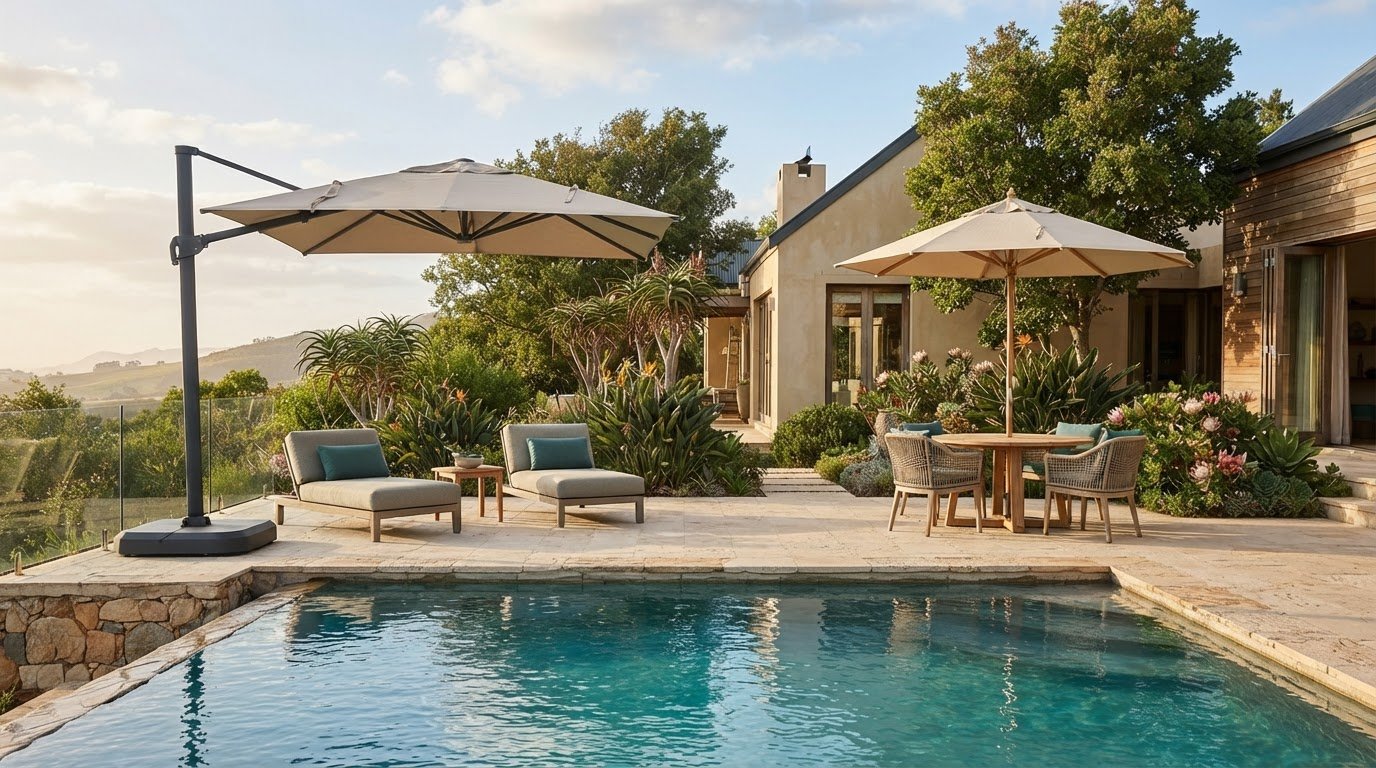
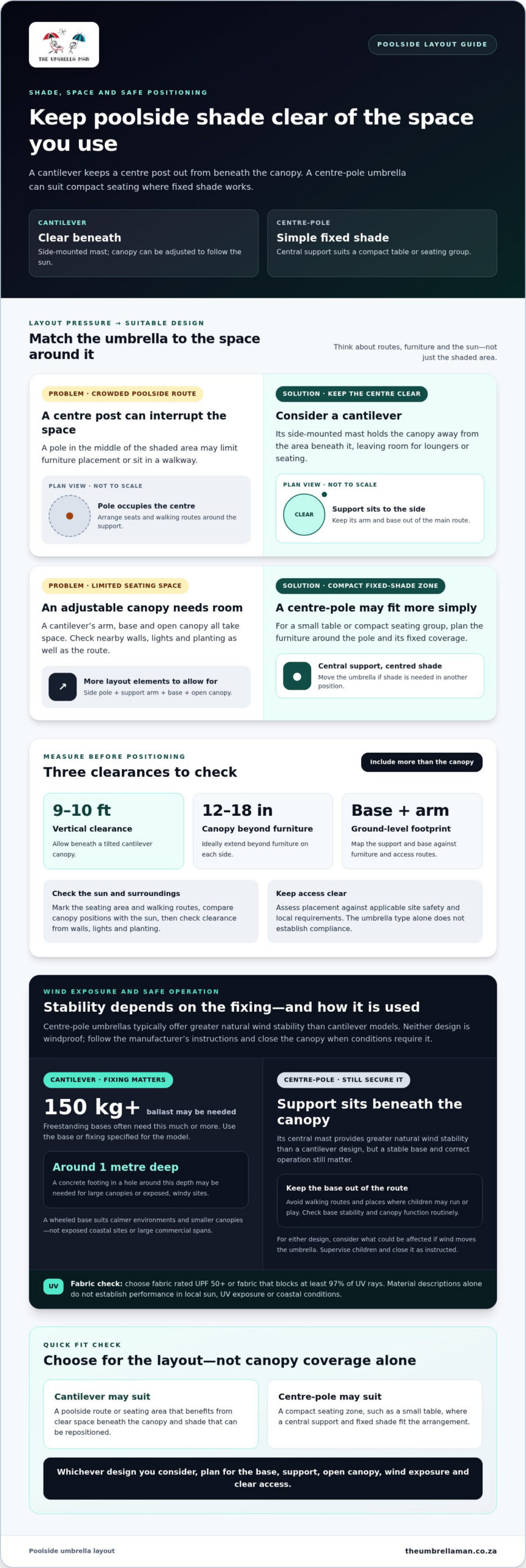
A cantilever umbrella holds its canopy out from a side-mounted pole, leaving the area directly beneath it clear. This layout can shade pool loungers or a seating area without placing a centre post among them. Many models offer 360-degree rotation and tilt, although adjustment options vary by model. Position the base outside the main route, then align the canopy with the seating and sun. Allow 9-10 ft of vertical clearance beneath a tilted canopy.
Centre-pole layouts and shade coverage
A centre-pole umbrella supports its canopy from below, with the pole in the middle of the shaded area. This can work well over a small table or compact seating group, but the pole may limit furniture placement or sit in a walkway. The shade remains centred unless you move the umbrella. Centre-post models may tilt, but generally do not rotate independently of their base. Plan the layout around the pole and the fixed coverage it provides.
Poolside coverage, rules and prices
Compare the canopy position with the sun and the area people will use. A canopy should ideally extend 12-18 inches beyond furniture on each side. A cantilever can rotate or tilt to reposition shade, while a centre-pole umbrella can be moved when another position is needed. For South African poolside planning, assess placement against the site’s applicable safety and local requirements, especially clear access. The umbrella type alone doesn’t establish compliance. Typical prices vary with canopy dimensions, fabric, adjustment mechanism and base or fixing.
| Option | Space beneath canopy | Shade positioning | Layout consideration |
|---|---|---|---|
| Cantilever | Clear of a centre post | May rotate or tilt | Plan room for the side pole and base |
| Centre-pole | Occupied by the pole | Fixed, or moved as needed | Arrange seating around the central support |
To choose, mark the seating area and walking routes first, then compare each canopy position with the sun. For example, a clear route beside the pool may favour a cantilever, while a small table with fixed shade may suit a centre pole. Include the base and pole in your layout, not just the canopy’s shaded area. Check that the open canopy clears nearby walls, lights and planting.
Wind exposure and safe operation
Centre-pole umbrellas typically offer greater natural wind stability than cantilever models. Neither should be left open in conditions that call for closing it, and stability depends on the base or fixing.
Cantilever umbrella wind performance
A cantilever’s canopy sits away from its side-mounted mast, so wind can place force on both the canopy and supporting arm. Use the base or fixing specified for that model, rather than treating a heavier-looking base as automatically suitable. Freestanding bases often need 150 kg or more of ballast. Large canopies or exposed, windy sites may need a concrete footing in a hole around one metre deep.
Follow the manufacturer’s operating instructions and close the umbrella when conditions require it. This matters beside a pool, where an open canopy could affect people, furniture or nearby property if it shifts. A wheeled base suits calmer environments and smaller canopies, rather than exposed coastal sites or large commercial spans. It can be repositioned, but mobility does not replace suitable ballast or safe operation.
Centre-pole umbrella wind performance
A centre-pole umbrella’s support runs directly beneath its canopy, and market umbrellas typically offer greater natural wind stability than cantilever designs. That does not make a centre-pole model windproof. Keep its base stable, check that the canopy functions properly, and close it when the manufacturer’s instructions or conditions require it.
For a poolside layout, consider what could be affected if wind moves the umbrella. Keep the pole and base clear of walking routes, and avoid placing them where children may run or play. Unlike a cantilever’s extended support arm, the central mast concentrates support beneath the canopy, but its base still needs a stable position.
Materials, weather and poolside safety
For wind stability, the base and fixing matter more than the frame material alone. Marine-grade aluminium frames and high-quality fabrics are used for cantilever umbrellas; centre-pole models may use aluminium or steel frames and Sunbrella fabrics. These material descriptions don’t establish how a particular umbrella performs in local sun, UV exposure or coastal conditions. For UV protection, choose fabric rated UPF 50+ or fabric that blocks at least 97% of UV rays.
Neither design is automatically safer beside a swimming pool or around children. Keep bases and operating parts out of walkways, supervise children around the umbrella, and close it as instructed when conditions require. Routinely check a centre-pole base’s stability and the canopy’s function; for a cantilever, follow the operating instructions and check its rotation. These steps address different risks: tripping, movement in wind and obstruction around poolside furniture.
Base footprint and walkway clearance
Base footprint can determine whether an umbrella fits a poolside dining area or narrows a walkway. Measure the base, support arm and open canopy, then compare them with the furniture and access routes.
Installation and base options
Cantilever models can use a surface plate, in-ground anchor, wall base bracket or freestanding base. Centre-pole umbrellas can also use a flat plate, concrete base, surface plate, in-ground anchor or freestanding base. A fixed connection on paving or decking needs suitable support beneath the surface. Establish this before installing the fixing.
For a cantilever layout, allow a patio width of 10-12 ft to accommodate the base and seating. Its arm typically extends 4-6 ft outwards, so leave that much clear space behind the pole. Then map the open canopy against walls, lights, signs and planting. This helps prevent the arm or canopy from colliding with nearby features as the umbrella opens.
Base weight, anchoring and stability
A freestanding cantilever needs a suitable weighted base; a fixed model needs an appropriate ground fixing. Cantilever bases may weigh 200-400+ lbs or require permanent mounting. Cross bases are commonly 24-36 inches wide, so include their full span in your measurements. A larger canopy or exposed position can affect the fixing needed for stability.
Centre-post umbrellas for residential and café settings generally need a weighted base of 50 to 80 kg. The base sits close to the pole, but still takes up floor space and can create a trip hazard. A freestanding market umbrella base needs 18-24 inches of clearance around the pole. Keep this space clear when arranging chairs, tables and routes to the pool.
Compare each base position with the furniture before deciding. For example, a centre pole near a dining table may fit the layout, while its base could interrupt the route around the table. A cantilever’s base can sit away from the shade, but its extended arm needs open space. Mark each footprint on the paving, including clearance around the pole and behind the cantilever mast.
Finally, account for the fixing beneath the surface. Before fitting an anchor into decking or paving, establish whether the structure below can support it. A freestanding base avoids that ground connection but occupies usable floor space. Choose the mounting approach that suits the site, then arrange furniture around the umbrella’s full footprint, not just the canopy.
What is the difference between a cantilever and a centre-post umbrella?
The main difference is where each design supports its canopy. That structure affects how you arrange tables, loungers and other furniture beneath the shade.
Cantilever umbrella design
A cantilever umbrella carries its canopy on an arm attached to a side pole. This leaves the area directly underneath open, unlike a centre-post design with a mast in the middle. Depending on the model, the arm can allow the canopy to rotate or tilt. For example, position the support beside loungers, then adjust the canopy over them as the sun moves.
Centre-pole and centre-post designs
A centre-pole, or centre-post, umbrella supports the canopy from a mast directly beneath it. The pole occupies the middle of the shaded area, so tables and chairs need to be arranged around it. This differs from a cantilever, where the support stands to one side. Centre-pole umbrellas are generally easier to install, and their fixed shade can suit a straightforward seating layout.
Market umbrella design
A market umbrella is a centre-pole style, with its supporting mast beneath the canopy. This makes it a practical option for café seating or a dining table arranged around the pole. Unlike a cantilever, it does not suspend shade over an open space from the side. The pole’s position matters: placing it in the middle of a table may work, while positioning it beside loungers can obstruct movement.
Think of the support as the main design trade-off. A cantilever keeps the central area clear, but its arm and side pole determine where the umbrella can stand. A centre-pole model uses a simpler central support, but that support takes up space beneath the canopy. At a pool, this distinction matters when people need to move between seating and the water.
Before choosing, sketch the furniture arrangement and mark the umbrella’s support position. For a cantilever, place the side pole where its arm can reach the intended shade area without crossing a route. For a centre-pole model, mark the mast within the table or seating arrangement. This makes it easier to see whether the support interrupts access or leaves useful space clear.
Also consider whether the shade position needs to change. Cantilever models differ in whether they tilt, rotate or offer both adjustments, so the design alone does not show their full range of movement. Centre-pole umbrellas can be moved when shade is needed elsewhere, but their canopy remains centred on the pole. Choose based on the layout and how you’ll use the shaded space.
For café seating, a centre-pole market umbrella can suit tables grouped around its mast. For loungers beside a pool, a cantilever can keep the support out of the space beneath the canopy. The difference is not just appearance: it determines where the support sits, how people move around it and whether the available shade can be repositioned.
Centre-pole umbrella uses
A centre-pole umbrella works best where the central mast fits naturally into the seating plan. Café tables are a clear example: the pole can sit through the table’s centre, keeping the canopy over diners without a side arm reaching across the space. Around a pool, the same arrangement can suit a compact table or defined seating zone, provided the pole does not interrupt a route to the water.
Smaller patios can also benefit from this straightforward layout. Place the pole within a table grouping, then arrange chairs around it and keep the base clear of foot traffic. Unlike an offset canopy, the shade stays centred over the support. This makes its position easy to plan when the intended use is fixed, such as shading one table rather than following the sun across several loungers.
Centre-pole models are practical for straightforward shade that does not need frequent repositioning. They typically tilt, but do not rotate independently of their base. If the sun shifts, you can move the umbrella to another suitable position. This works best where the base can be lifted and relocated without disrupting furniture or narrowing access. For a poolside dining table, moving the umbrella may be simpler than rearranging the whole seating area.
The support’s central position can be an advantage when furniture is arranged around it. A table with a central opening, for example, can accommodate the pole and keep the canopy aligned with diners. Without that arrangement, the mast may divide the seating area or obstruct movement. Before setting the umbrella in place, consider how people will approach the table and pass between the chairs.
For larger pool areas, a combination of centre-pole and cantilever umbrellas can serve different zones. A centre-pole model can shade a small dining group, while a cantilever can cover an open area where a central support would get in the way. This matches each umbrella to its use, rather than expecting one layout to suit every seating area.
Use this quick decision guide for a centre-pole design:
- Choose a fixed table or compact seating area where the pole can sit centrally.
- Leave the base outside the main path between the seating and pool.
- Plan for the canopy to remain centred, or move the umbrella when the desired shade position changes.
- Use a separate shade zone where loungers or open space need coverage without a central mast.
If portable shade suits your outdoor layout, explore beach umbrella options for use in suitable outdoor settings.
The Umbrella Man: 2.0m 160gm Poly-Canvas Beach Umbrella
The Umbrella Man offers the 2.0m 160gm Poly-Canvas Beach Umbrella for portable shade in suitable outdoor settings. It is a beach umbrella, not a cantilever or centre-pole pool umbrella, so consider it for outdoor use where its format suits the space rather than as a substitute for a fixed poolside layout.
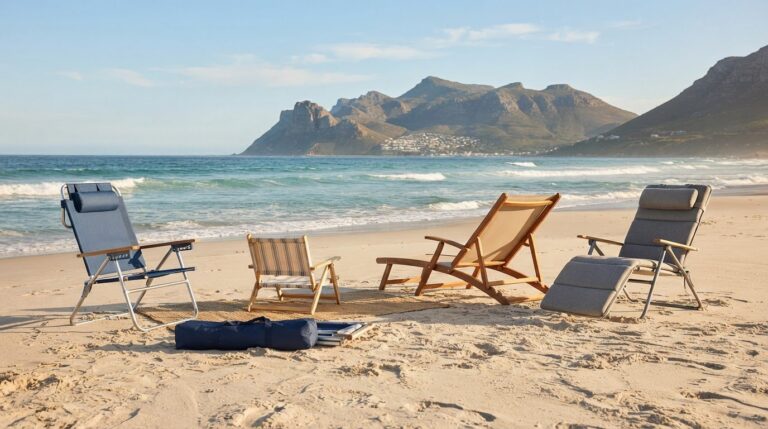
For a coordinated beach setup, the 2.0m 190T Poly Nylon Beach Umbrella and 2.56m Garden Pattern Umbrella are also available, alongside the 7-Level Steel Beach Chair. Match the umbrella and seating to how you plan to use the area.
For product information, contact The Umbrella Man or visit theumbrellaman.co.za.
Plan your next step for poolside shade
Make the final choice based on how you’ll use the space, not just the canopy shape. The cantilever umbrella versus centre-pole decision for pools becomes clearer once you’ve marked the seating, access routes and position where shade is most useful. This practical layout also helps distinguish fixed poolside coverage from portable shade for other outdoor activities.
The Umbrella Man’s range includes the 2.0m 160gm Poly-Canvas Beach Umbrella, the 2.56m Garden Pattern Umbrella and the 2.0m 190T Poly Nylon Beach Umbrella. These are beach umbrella options, rather than cantilever or centre-pole pool umbrellas, so consider them for outdoor use where portable shade suits your plans.
For guidance on these umbrella options, contact The Umbrella Man. A considered layout and a suitable shade choice can help you make better use of your outdoor space.
Frequently Asked Questions
Are cantilever umbrellas safe in windy conditions?
They can be operated safely only when secured with the fixing specified for that model and used according to its instructions. An offset canopy and supporting arm are exposed to wind, so close the umbrella when conditions require it. For example, don’t leave it open simply because the base feels heavy. Freestanding cantilever bases often need 150 kg or more of ballast, but the required support depends on the model and site.
Cantilever vs Market Umbrella: Which is Best for Your Space?
A market umbrella is a centre-pole design, so choose it where a central support fits the furniture plan. It can work over a café-style table or a defined dining spot. A cantilever is more suitable where you want shade over a poolside area without a pole in its centre. For a mixed layout, decide whether the priority is open space beneath the canopy or a simple, centred shade position.
Do cantilever parasols need a special base?
Use a base or fixing specified for the particular model, not an arbitrary umbrella stand. Options include a weighted freestanding base, surface plate, in-ground anchor or wall base bracket. Fixed mounting needs a suitable supporting structure beneath paving or decking. For example, a wall bracket suits a position beside a structurally suitable wall, while a freestanding base avoids a permanent ground connection.
How heavy does a cantilever umbrella base need to be?
Freestanding cantilever bases often need 150 kg or more of ballast, but that figure isn’t a universal specification for every umbrella. Canopy size, exposure and the model’s fixing instructions affect the required support. Use the manufacturer-specified base or anchoring method. For a large canopy or an exposed, windy site, an in-ground concrete footing may be appropriate; the fixing must suit the ground and umbrella.
What are the main differences between cantilever and centre-pole umbrellas for pool areas?
If you’re weighing a cantilever umbrella versus a centre-pole umbrella for pools, start by considering where each design places its support. A cantilever’s side pole and arm leave the central area beneath the canopy open; a centre-pole mast occupies the middle. For example, a family arranging loungers around a clear space may prefer the offset support, while a table with a central opening can accommodate a centre pole.
Which type of pool umbrella provides better shade coverage and adjustability?
The cantilever umbrella versus centre-pole choice for pools depends on how the shade needs to shift across the seating area. Cantilever models may rotate, tilt or offer both adjustments, while centre-pole umbrellas generally keep shade centred over the mast. Identify which seats need shade at different times, then consider whether adjusting the canopy or moving the whole umbrella better suits the layout.
Which umbrella base or anchoring options are suitable for poolside use?
Suitable options include a freestanding weighted base, surface plate, in-ground anchor or wall base bracket, depending on the umbrella and site. A centre-pole model can also use a concrete base. For example, a fixed anchor can preserve floor space, while a freestanding base avoids a permanent connection. Before fixing into paving or decking, establish whether the structure beneath can support the installation.
How much space and clearance does each type of pool umbrella need?
A cantilever layout needs room for its base, arm and open canopy; its arm typically extends 4-6 ft from the pole. A patio at least 10-12 ft wide is recommended for its base and seating. Centre-pole layouts need clearance around the base, with 18-24 inches around a freestanding market umbrella base to reduce trip hazards. Measure the complete footprint against furniture and walking routes.